
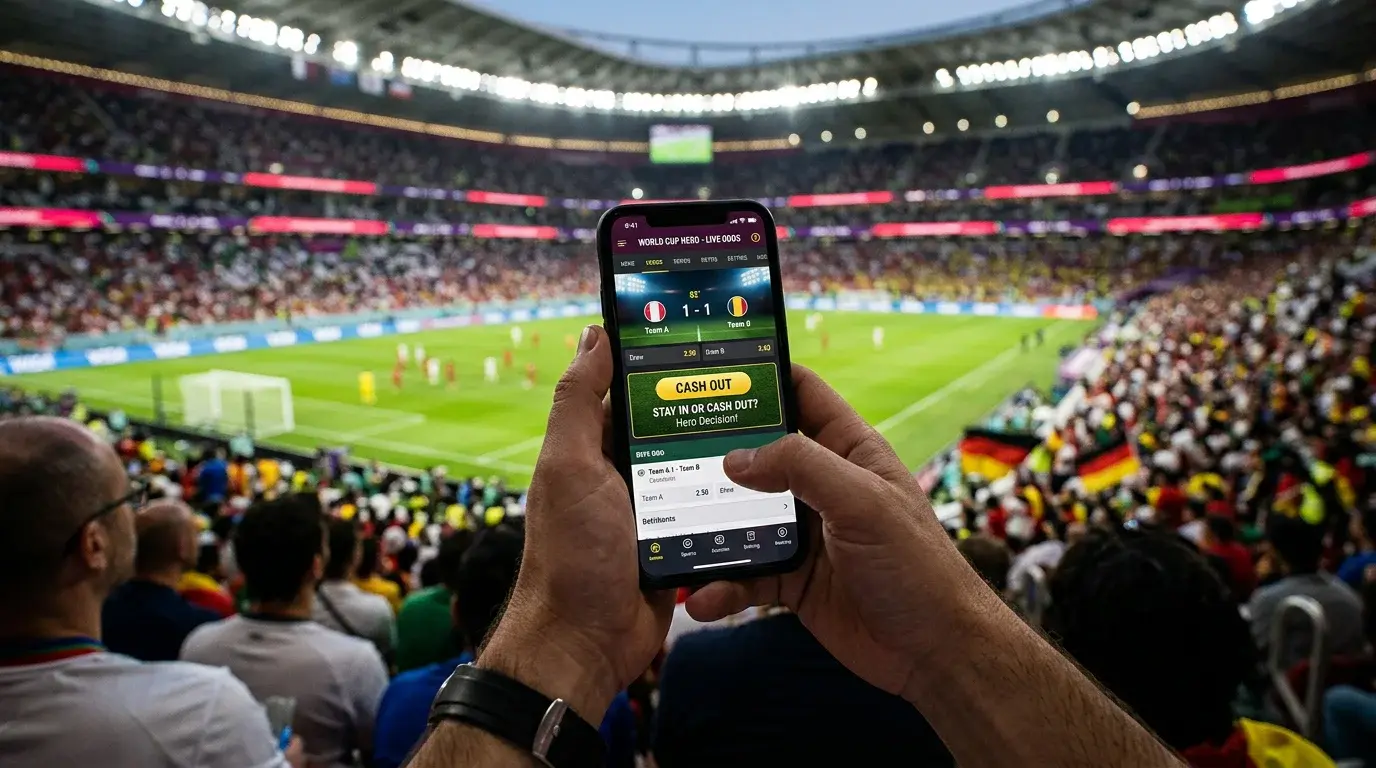
The notification arrived during extra time of a 2018 quarter-final. My pre-tournament accumulator had landed four legs and needed one more for a payout exceeding twelve hundred euros from a fifty euro stake. The bookmaker offered immediate cashout at four hundred and sixty euros. I stared at the screen for ninety seconds, declined, watched the fifth leg win, and collected the full amount. Two years later, in a different tournament, I declined a similar offer, watched the final leg collapse, and received nothing. Same decision framework, opposite outcomes. The cashout question haunts every punter who builds positions that develop value during tournaments.
World Cup cashout decisions compound across 39 days of evolving positions. Outright bets shift value as teams progress or falter. Accumulators accumulate anxiety alongside their accumulating legs. In-play positions swing wildly with each goal and card. This guide establishes the framework I use for cashout decisions, distinguishing between emotion-driven impulses that destroy value and information-driven reassessments that protect it.
How Bookmaker Cashout Actually Works
Cashout functions as a new bet against your existing position. The bookmaker calculates your position’s current value based on live odds, then offers you less than that value to close your exposure. The difference between true current value and offered cashout represents their margin on the closing transaction. Understanding this mechanism transforms how you evaluate cashout offers.
Consider a pre-tournament bet on Scotland to reach the knockout rounds at 4/5, staking twenty euros for potential return of thirty-six euros. After Scotland beats Haiti and draws Morocco, their knockout qualification probability increases substantially. Live odds might now show Scotland to qualify at 1/5. Your position’s true current value sits around twenty-eight euros based on probability-weighted expected return. The bookmaker offers cashout at twenty-four euros. That four euro gap represents their margin for assuming your remaining risk.
The mathematics become clearer with explicit calculation. At 1/5 current odds for qualification, true probability sits around 83%. Your remaining expected value equals 83% multiplied by thirty-six euros, producing roughly thirty euros. The twenty-four euro cashout offer means surrendering six euros of expected value. That surrender might be justified by risk aversion or liquidity needs, but it is never justified by the illusion that you are “locking in profit.” You are accepting worse terms than probability suggests your position deserves.
The margin on cashout typically runs higher than initial market margins. Bookmakers understand that punters wanting cashout are emotionally invested in closing positions, either from anxiety about potential loss or eagerness to lock profit. This emotional leverage allows them to offer worse terms than the underlying probability justifies. Every cashout decision must acknowledge that accepting the offer means accepting worse-than-fair terms.
Partial cashout options create additional complexity. Cashing out half your position at reduced terms while letting half ride sounds like balanced risk management. In practice, partial cashout doubles the margin extraction: you pay the cashout spread on half, then continue holding a position whose effective odds have worsened relative to maintaining the full original stake. I avoid partial cashout entirely unless genuine new information demands position reduction rather than full closure or full continuation.
When Cashout Actually Makes Sense
Three circumstances justify cashout despite its inherent value destruction. Each involves new information that fundamentally changes your position’s expected value beyond what the bookmaker’s price adjustment captures. Outside these circumstances, cashout represents surrendering edge you created through correct initial analysis.
Significant injury to a key player whose contribution your bet depends upon warrants cashout consideration. If your Scotland qualification bet relies heavily on Andrew Robertson’s defensive organisation, and Robertson suffers a serious injury mid-tournament, your probability assessment shifts more than the market adjustment reflects in the immediate aftermath. Cashing out captures some value before the full market recalibration occurs. The bookmaker’s cashout offer lags behind the true probability shift because their models update slower than informed bettors’ assessments.
Tactical revelation that contradicts your original thesis creates similar justification. If you backed a team expecting attacking football, but their opening matches reveal deep defensive approaches that suppress the goal-scoring your bet required, cashing out acknowledges your original analysis proved wrong. The market adjusts gradually; your cashout captures value before full adjustment completes. This differs from single-match performance variance: tactical identity revealed across multiple fixtures provides genuine new information rather than random outcome noise.
Liquidity need unrelated to the bet itself occasionally forces cashout regardless of value considerations. If life circumstances require the capital your betting position ties up, extracting available value beats waiting for resolution you cannot afford. This represents pragmatic reality rather than strategic choice, but recognising it as distinct from value-based decisions maintains clarity about why you cashed out.
When to Refuse Cashout
The majority of cashout impulses reflect emotional response rather than analytical reassessment. Distinguishing between the two protects accumulated value from erosion through anxiety-driven decisions.
Refusing cashout after favourable results seems counterintuitive but often maximises expected value. Scotland leading Haiti 2-0 at halftime triggers cashout offers that assume some probability of second-half collapse. Your original analysis presumably anticipated Scotland winning this match convincingly. Nothing in the first half contradicts that assessment. The cashout offer reflects bookmaker hedging, not new information. Maintaining position captures the full expected value your analysis identified rather than surrendering portion to bookmaker margin.
Refusing cashout during nervous moments requires emotional discipline that tournaments test relentlessly. The 85th minute of a tight knockout match with your accumulator needing one more win produces peak anxiety. Cashout offers spike as bookmakers anticipate emotional capitulation. Yet if your original probability assessment remains valid, the nervousness reflects outcome uncertainty that was always present, not new information changing expected value. I set pre-match rules about when I will consider cashout and refuse to engage the feature outside those predetermined circumstances.
Refusing cashout on positions that represent your entire tournament allocation demands particular discipline. If your sole outright bet on Argentina to win the tournament reaches the semi-final stage, cashing out captures certain profit against uncertain final outcome. However, your original stake represented probability-weighted expected value at the initial price. Semi-final entry was always part of that expected path. Cashing out now means you paid for tournament winner probability at pre-tournament prices but accepted reduced payout before tournament conclusion. The mathematics favour continuation unless new information genuinely changed Argentina’s winning probability beyond what their tournament progression already implied.
The Emotional Cashout Trap
Bookmakers design cashout interfaces to maximise emotional engagement. Flashing green profit figures, countdown timers suggesting urgency, and prominent placement during high-anxiety moments all encourage impulsive decisions that favour the house. Recognising these psychological triggers protects against value destruction disguised as profit capture.
The sunk cost fallacy operates in reverse with cashout. Normal sunk cost fallacy makes people continue losing positions to justify prior commitment. Cashout triggers the opposite: the fear of losing accumulated unrealised profit creates pressure to capture gains before they evaporate. Both responses reflect emotional rather than probabilistic thinking. Your current position has specific expected value based on current probabilities. Whether you are currently “up” or “down” on that position should not influence decisions about its expected future value.
Time pressure amplifies emotional decision-making. In-play cashout offers change rapidly, creating urgency that bypasses analytical thinking. I never engage in-play cashout features during live matches except in the genuine new information circumstances described above. If injury occurs, I pause, assess properly, then decide. The thirty seconds of deliberation costs less value than the impulsive cashout accepted without proper assessment.
The morning after a refused cashout that subsequently lost delivers painful emotional lessons. My system for handling this involves writing down my reasoning before refusing. When the position loses, I revisit that reasoning. If the analysis was sound but the outcome unfavourable, no lesson exists beyond accepting variance. If the reasoning reveals analytical error, that lesson improves future decisions. Either way, documenting the decision framework before outcome revelation protects against hindsight bias that distorts future decision-making.
My World Cup Cashout Framework
For the 2026 World Cup, I establish cashout rules before placing any stake. These rules remove in-moment decision pressure by precommitting to responses under specific circumstances.
Outright tournament winner bets: no cashout consideration before the semi-final stage unless significant injury affects my selection’s primary players. At semi-final stage, I evaluate whether the remaining path probability justifies continuation versus accepting the guaranteed return. If my team reaches the final, I let it ride regardless of opponent or cashout offer. The final represents maximum probability concentration that my original stake purchased.
Group stage qualification bets: no cashout consideration until my selection has played two matches. After two matches, I reassess whether revealed tactical approach and form trajectory matches my original thesis. If significant divergence exists, cashout protects remaining value. If performance confirms expectations, I maintain position through the third match regardless of cashout offers during match play.
Accumulators: I set maximum acceptable cashout percentage before placing the bet. If the acca builds to a position where cashout exceeds that threshold, I consider it seriously. My typical threshold sits at 60% of maximum potential return. Reaching 60% with meaningful risk remaining justifies capturing that return. Below 60%, the remaining upside justifies accepting remaining risk.
In-play positions: no cashout feature engagement during live matches. Ever. In-play cashout decisions made during match action reflect emotional state rather than analytical assessment. I set positions before kickoff and let them resolve. If I cannot accept that approach for a particular match, I do not place in-play positions.
These rules eliminate most cashout decisions by precommitment. The mental bandwidth saved from not constantly evaluating cashout offers redirects toward analysis that creates value rather than anxiety that destroys it. The World Cup creates enough emotional intensity without adding cashout management to every match involving your positions. Establish your framework now, document it, and follow it mechanically through the tournament. Your bankroll will thank you for the discipline your in-moment emotional state would otherwise undermine.