

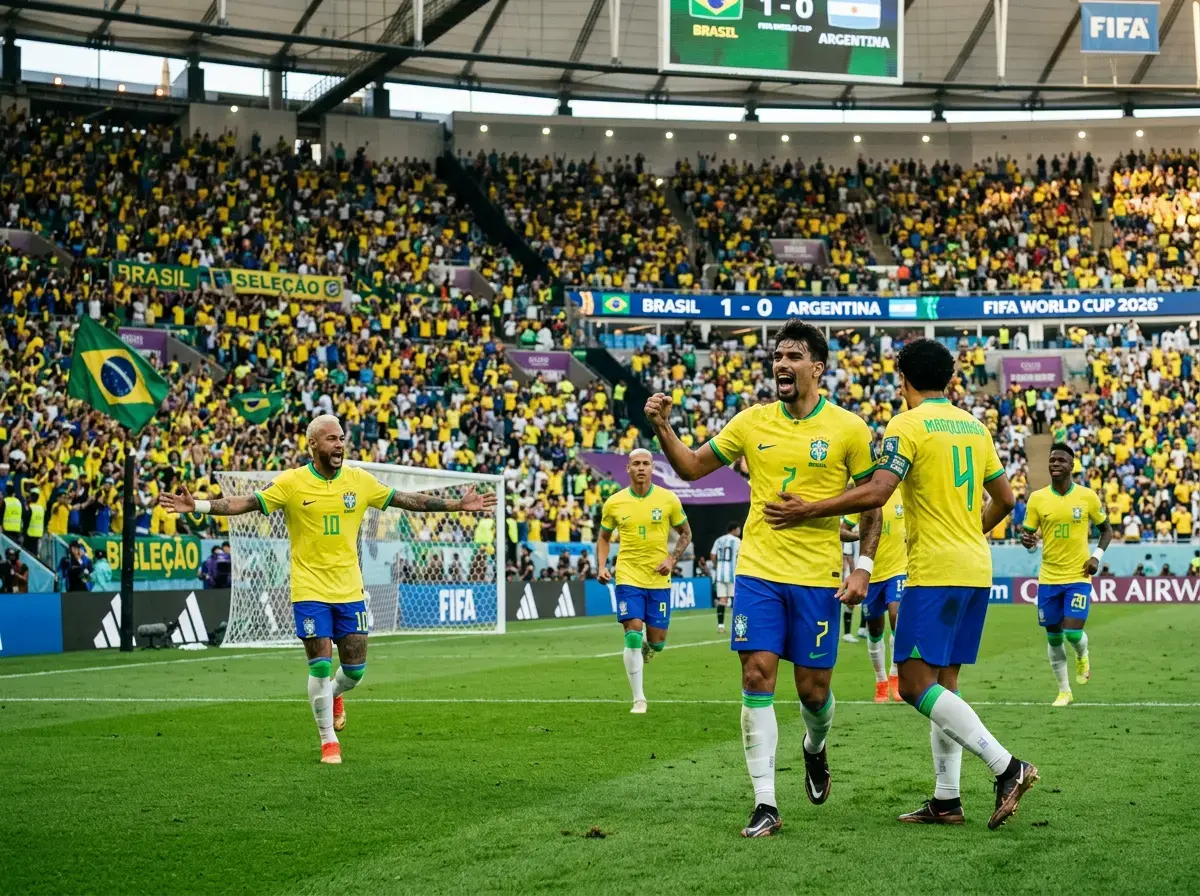
Twenty-four years without a World Cup trophy. For any other nation, that statistic would represent a golden era. For Brazil — five-time champions, inventors of the beautiful game, eternal favourites — it constitutes the longest drought in their history. The last Brazilian celebration came in Yokohama in 2002, when Ronaldo’s brace destroyed Germany and a young Ronaldinho danced through the tournament with a smile that captured the world’s imagination. I was barely out of school when that happened, and in the intervening decades, Brazil have produced heartbreak after heartbreak: the 7-1 Mineirão massacre against Germany in 2014, the quarter-final exit to Belgium in 2018, the penalty shootout defeat to Croatia in 2022. Now they arrive in America as second favourites behind Argentina, carrying the weight of a nation that demands nothing less than the sixth star on their famous yellow jersey.
Brazil World Cup betting markets tell a consistent story. The Seleção sit at approximately 9/2 for outright victory, trailing only the defending champions. Bookmakers respect the talent — Vinícius Jr has emerged as the world’s most devastating winger, Rodrygo provides silky complementary quality, and the squad depth from goalkeeper to striker rivals anyone in the tournament. But the pricing also reflects recent tournament failures. Brazil have not won a knockout match at a World Cup since 2018, a statistic that should give bettors pause. The question hanging over this campaign is straightforward: does this generation possess the mentality to handle pressure when it matters most?
I approach Brazil World Cup betting with cautious optimism. The talent level is undeniable — on pure ability, this squad ranks among the top three in the tournament alongside Argentina and France. The coaching situation has stabilised under Carlo Ancelotti, whose appointment in December 2024 brought European tactical sophistication to a federation that had been lurching between appointments. The group draw favours a comfortable qualification through Group C, where Morocco, Scotland, and Haiti offer progressively easier opposition. Yet something indefinable has been missing from Brazilian football since 2002, and I am not convinced that Ancelotti has found it. My verdict places Brazil as genuine contenders who are slightly overpriced at current odds, but I would not back them outright without hedging through alternative markets.
Squad Analysis: Depth Beyond the Stars
Carlo Ancelotti inherited a squad brimming with individual talent but lacking cohesive identity. His first task was establishing defensive solidity — something Brazilian teams have historically sacrificed in pursuit of attacking flair. The results have been encouraging. Since Ancelotti’s appointment, Brazil have conceded just six goals in twelve matches, a dramatic improvement on the leaky defences that contributed to recent tournament exits.
The goalkeeper position features Alisson Becker as the undisputed starter. Liverpool’s number one remains among the elite shot-stoppers globally, combining excellent reflexes with commanding presence in the box. His distribution allows Brazil to play out from the back under pressure, an essential component of Ancelotti’s possession-based approach. Behind Alisson, Ederson provides world-class backup — a luxury most nations cannot contemplate. The Manchester City keeper’s sweeper-keeper abilities offer a tactical alternative if Ancelotti wants to push his defensive line higher against weaker opposition.
In defence, the centre-back pairing of Marquinhos and Gabriel Magalhães has solidified over the past eighteen months. Marquinhos brings experience and reading of the game that settles the entire backline, while Gabriel’s physical presence makes Brazil formidable on set pieces at both ends. Full-back options include Danilo on the right — veteran presence with tactical discipline — and Guilherme Arana or Wendell on the left. The depth here is adequate rather than exceptional, which represents a potential vulnerability if injuries strike.
Midfield is where Ancelotti has worked hardest to find balance. Bruno Guimarães anchors the centre with controlled passing and positional awareness that allows the creative players ahead of him to take risks. Lucas Paquetá operates as the primary ball-carrier, driving forward from deep positions with the technical quality that characterised his breakthrough at Lyon and West Ham. Casemiro’s international career appears to be winding down, but his experience remains valuable in high-pressure knockout matches. The surprise package of qualification was João Gomes, whose pressing intensity and box-to-box energy earned him a starting role against Argentina in Buenos Aires — a match Brazil won 2-1 with their most complete performance in years.
The attack requires no introduction. Vinícius Jr has established himself as a Ballon d’Or contender, his explosive dribbling and clinical finishing making him virtually unplayable when space opens up. Rodrygo provides complementary quality on the opposite flank or through the centre, his movement and finishing ability perfectly suited to Ancelotti’s fluid attacking schemes. Raphinha adds width and work rate, his willingness to track back defensively making him invaluable in tournament football. The striker position remains more uncertain — Richarlison’s form has fluctuated, while Endrick’s raw talent lacks the experience required for starting roles against elite opposition. This is perhaps the one area where Brazil’s depth falls short of their rivals.
Group C Preview: Brazil’s Path to Round of 32
The draw gods smiled on Brazil. Group C contains Morocco — a genuine test of credentials — alongside Scotland and Haiti, neither of whom should threaten the Seleção’s progression. This is the kind of group that Brazil must navigate without dropping points if they want to send a message to tournament rivals.
Morocco represent the only significant obstacle. Walid Regragui’s side reached the semi-finals in Qatar, eliminating Spain and Portugal through defensive organisation and clinical counter-attacking. They possess the personnel to make life uncomfortable: Achraf Hakimi’s overlapping runs, Sofiane Boufal’s creativity, and the collective spirit that defines North African football. Brazil versus Morocco in the group stage has the makings of a tactical battle, with both managers likely to prioritise not losing over aggressive pursuit of victory. I expect a tight match, probably 1-1 or a narrow 2-1 either way.
Scotland arrive as our Celtic neighbours’ best hope of tournament progression, but realistically they face an enormous challenge against Brazil. Steve Clarke’s side will defend deep, frustrate, and hope for set-piece opportunities. Brazil’s technical superiority should eventually tell, though the margin may be smaller than bookmakers suggest. I project a 2-0 or 3-0 Brazil victory, with the Seleção needing to show patience against a well-organised defensive block.
Haiti complete the group and offer Brazil an opportunity to rotate while still securing comfortable victory. The CONCACAF qualifiers lack the individual quality to compete with anyone in Group C, and Brazil should win by three or four goals with a second-string lineup. This match serves primarily as rest for key players ahead of knockout football.
The qualification permutations are straightforward. Brazil winning all three matches — the expected outcome — places them as group winners with maximum points. This likely sets up a Round of 32 fixture against a third-placed team from Groups A, B, or D, followed by a Round of 16 clash against a Group E or F runner-up. The path to the quarter-finals looks navigable, though any complacency could result in a shock exit against motivated underdogs.
Key Players: Vinícius Jr, Rodrygo & The New Generation
Vinícius Jr carries Brazilian hopes on his shoulders, and everything suggests he is ready for the responsibility. The Real Madrid winger has evolved from raw talent into complete forward, adding end product to his devastating dribbling ability. His 2024-25 club season produced 28 goals and 14 assists across all competitions, numbers that place him among the world’s elite attackers. In the Ballon d’Or voting, he finished second behind only Jude Bellingham — recognition of sustained excellence rather than fleeting brilliance.
What makes Vinícius special is his combination of speed, skill, and psychological resilience. The racism he has endured in Spanish football would have broken lesser players, but Vinícius has channelled adversity into motivation. His response to abuse has been to perform at an even higher level, demonstrating mental fortitude that translates directly to tournament pressure. When Brazil need a moment of magic in the quarter-final or semi-final, Vinícius possesses the ability and the temperament to provide it.
Rodrygo operates in the shadow of his more celebrated teammate, yet his contribution to Real Madrid’s Champions League victories proves he belongs at the highest level. His late goals against Manchester City in 2022 remain among the most dramatic in competition history, and that clutch gene makes him invaluable in knockout football. Rodrygo can play across the forward line — as a false nine, a traditional winger, or an inverted playmaker — giving Ancelotti tactical flexibility that other coaches lack. Expect him to start most matches, either alongside Vinícius or in central positions depending on the opposition.
Bruno Guimarães has become essential to Brazilian football. The Newcastle midfielder provides the defensive screening that allows Vinícius and Rodrygo to attack without tracking back, while his passing range creates opportunities from deep positions. In qualification, Guimarães averaged more progressive passes per match than any other Brazilian player, knitting the team together with intelligence rather than flash. His partnership with Lucas Paquetá offers technical quality in central areas that rivals any midfield pairing in the tournament.
The new generation extends beyond the obvious stars. Endrick, still only 19, represents the future of Brazilian football despite limited tournament opportunities. His movement and finishing suggest a natural goalscorer, and Ancelotti has shown willingness to use him from the bench when matches require fresh legs and unpredictable energy. Savinho emerged as a creative force during his loan spell at Girona before moving to Manchester City, his dribbling and crossing providing alternative options when established starters need rest. This generation possesses technical ability to match any in Brazilian history — the question is whether they have the collective mentality to win seven consecutive matches against elite opposition.
World Cup History: 5 Stars, 20 Years of Waiting
Those five stars on the Brazilian jersey carry weight that no other nation can match. Five World Cup victories — 1958, 1962, 1970, 1994, 2002 — represent unparalleled success in international football. Pelé, Garrincha, Zico, Romário, Ronaldo: the roll call of Brazilian legends reads like a comprehensive history of the sport itself. Yet the younger generation of Brazilian supporters has never witnessed their country lifting the trophy. A twenty-year-old watching the 2026 World Cup was not born when Ronaldo destroyed Germany in Yokohama.
The 2014 humiliation against Germany haunts Brazilian football to this day. Playing a home World Cup, with an entire nation expecting glory, Brazil collapsed 7-1 in the semi-final. That match exposed psychological fragility that subsequent generations have struggled to overcome. The tears of David Luiz, the devastation on the faces of supporters — these images remain seared into collective memory. Every Brazilian team since has carried the burden of that failure, knowing that pressure on home soil proved too much for their predecessors.
Qatar 2022 offered hope of redemption before penalty heartbreak intervened. Brazil dominated Croatia through 120 minutes, creating chance after chance without finding the decisive goal. When penalties arrived, the pressure told — Rodrygo and Marquinhos both missed, and Dominik Livaković proved equal to everything Brazil threw at him. The pattern of recent tournaments suggests Brazilian teams perform adequately in group stages and early knockouts, then falter when the stakes reach their peak. Breaking that pattern requires either exceptional fortune or genuine psychological transformation.
Ancelotti’s appointment represents an attempt to address the mentality issue. The Italian has won the Champions League four times, including three with Real Madrid in the past decade. He understands how to prepare players for defining moments, how to create environments where pressure feels manageable rather than overwhelming. Whether his approach translates to international football — with limited preparation time and players conditioned by different club cultures — remains uncertain. But Brazilian football authorities clearly believe that importing European expertise offers the best chance of ending the trophy drought.
Historical precedent offers both hope and caution. Brazil have won World Cups in the Americas before — 1970 in Mexico produced the greatest team in history, while 1994 in the United States delivered unexpected triumph after years of underachievement. The 2026 tournament returns to North American soil, and Brazil’s large diaspora in cities like Boston and Miami will create supportive atmospheres for group-stage matches. Whether cosmic forces favour Brazilian football in America remains to be seen, but the historical pattern is at least encouraging.
The 1994 comparison feels particularly relevant. That Brazilian side, led by Romario and featuring a young Ronaldo on the bench, was not considered among the tournament favourites. They played functional, pragmatic football under Carlos Alberto Parreira — a departure from the jogo bonito tradition. Yet they won through defensive organisation and clinical finishing, proving that tactical discipline could coexist with Brazilian technical ability. Ancelotti’s approach shares philosophical similarities with Parreira’s methods: prioritise solidity, trust the attackers to produce moments of magic, and never lose a match through defensive negligence. If Brazil win this World Cup, they will do so through European efficiency as much as South American flair.
Betting Markets: Value or Overrated?
Brazil at 9/2 to win the tournament represents the second-shortest odds after Argentina. That pricing implies a probability of approximately 18%, which feels accurate given the squad quality and recent tournament record. The question for bettors is not whether Brazil can win — they obviously can — but whether the odds compensate adequately for the risks involved.
My assessment places Brazil slightly overpriced in outright markets. The value rating sits at 6/10 — not a screaming opportunity, but reasonable for those who believe Ancelotti has solved the mentality issues that plagued previous campaigns. I would not place significant stakes on Brazil to win the tournament, but a small position at 9/2 offers entertainment value throughout June and July.
Better value exists in alternative markets. Brazil to reach the final is available at approximately 11/4, which I rate 7/10 for value. This requires winning five matches — group stage plus Round of 32, Round of 16, quarter-final, and semi-final — without necessarily winning the final. Given Brazil’s squad quality and relatively kind group draw, reaching the last two represents an achievable target. The semi-final hurdle has proven Brazil’s stumbling block in recent tournaments, but with Ancelotti’s tournament experience, there is reason for cautious optimism.
Brazil to top Group C is essentially a formality at current odds of 1/4. The pricing offers no value whatsoever — you would need to stake €400 to win €100 — but the market accurately reflects reality. I cannot recommend backing Brazil at such short prices regardless of confidence level. The risk-reward ratio simply does not compute.
Individual player markets offer more interesting angles. Vinícius Jr for Golden Boot is available at 8/1, representing reasonable value for the tournament’s most dangerous attacker. My value rating sits at 7/10 — the odds adequately compensate for the competition from Kane, Mbappé, and Messi, while recognising Vinícius’s goal threat in Ancelotti’s system. Rodrygo to score in the tournament is 8/15, which I rate 5/10 — almost certain to happen but priced accordingly.
The total goals market intrigues me. Brazil over 7.5 tournament goals is available at 6/5, implying they need to average 2.5 goals across a minimum three matches or higher through knockout rounds. In qualification, Brazil averaged 2.8 goals per match, suggesting the over is achievable with typical attacking performance. I rate this 7/10 for value — a reasonable proposition at reasonable odds.
Against specific opponents, Brazil to beat Morocco offers the most interesting group-stage market. Current odds of 4/6 feel tight given Morocco’s quality, and I see minimal value in backing the Seleção here. Draw no bet on Morocco at 3/1 actually offers better risk-reward if you believe Regragui’s side can frustrate Brazil as they frustrated Spain and Portugal in Qatar. I rate Brazil to beat Morocco as 5/10 for value — the odds do not adequately compensate for genuine upset potential.
My Verdict: Will Brazil End the Drought?
Brazil possess the squad to win this World Cup. That statement is objectively true and requires no further qualification. Vinícius Jr, Rodrygo, Bruno Guimarães, Marquinhos, Alisson — these are elite players competing at the peak of their powers. Ancelotti brings tactical acumen and winning experience that previous managers lacked. The group draw facilitates comfortable qualification. All the ingredients exist for Brazilian success.
Yet I cannot shake the feeling that something remains missing. Brazilian football since 2002 has produced brilliant individual moments without delivering collective glory. The pattern repeats with monotonous regularity: dominate group stages, look impressive in early knockouts, then fall short when the pressure peaks. Until proven otherwise, I must assume this generation follows the template of their predecessors.
My prediction places Brazil in the semi-finals, where I expect them to face either France or England in a match that could go either way. They may well progress to the final — the talent level certainly supports that outcome — but lifting the trophy requires winning seven consecutive matches against increasingly difficult opposition. Argentina’s cohesion under Scaloni, France’s depth under Deschamps, England’s emerging generation under new management: any of these could halt Brazil’s progress at the crucial moment.
For betting purposes, I recommend the semi-final or better market at approximately 5/4 if available. This captures Brazil’s genuine quality while providing protection against final-round heartbreak. Avoid outright winner bets unless odds drift significantly above 5/1. Back Vinícius Jr for individual honours — Golden Boot at 8/1 represents the best value in Brazilian markets. And keep stakes modest throughout. Brazil at 9/2 looks attractive until you remember that 82% of such bets lose.
