

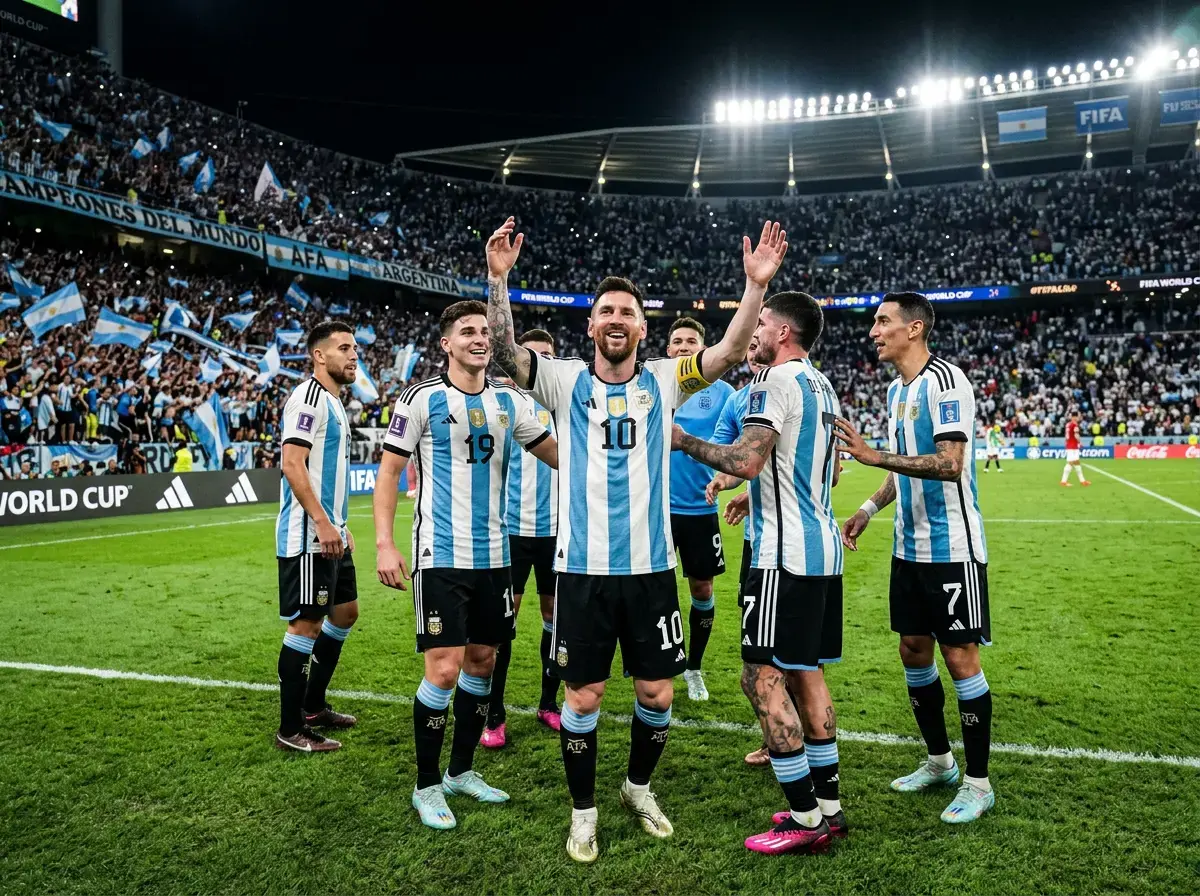
Lusail Stadium, 18 December 2022. Lionel Messi lifts the World Cup trophy above his head, wearing a bisht gifted by the Emir of Qatar, surrounded by teammates who had just delivered Argentina’s third World Cup in the most dramatic final in tournament history. I watched that match at 3am Irish time, barely breathing through 120 minutes of tension before Gonzalo Montiel converted the decisive penalty. That image of Messi — finally complete, finally vindicated — will define football’s greatest career. Now, three and a half years later, the question dominating Argentina World Cup betting markets is whether this team can do it again.
Defending a World Cup title is among the hardest achievements in sport. Since Brazil in 1962, no nation has successfully retained the trophy. Italy in 2010, Spain in 2014, Germany in 2018, France in 2022: all arrived as favourites and departed before the semi-finals. The pattern suggests that psychological factors — complacency, pressure, the weight of expectation — erode the advantages that made champions in the first place. Argentina face this historical headwind while simultaneously managing the transition beyond Lionel Messi, whose presence at 38 years old cannot be guaranteed through seven gruelling matches in American heat.
I approach Argentina betting with deep respect for what Lionel Scaloni has built. This is not a one-man team dependent on Messi’s brilliance — it is a cohesive unit where every player understands their role and executes it with remarkable consistency. The squad that won in Qatar has largely been preserved, with younger talents like Enzo Fernández and Julián Álvarez maturing into genuine world-class performers. At current odds of 7/2, Argentina represent fair value for bettors who believe that squad cohesion trumps the historical curse of defending champions. My verdict places them as the team most likely to win the tournament, though I recommend modest stakes given the inherent uncertainty.
The Messi Question: One Last Dance?
Every conversation about Argentina World Cup betting begins and ends with Lionel Messi. At 38, he will be the oldest outfield player in contention for major tournament impact since Miroslav Klose carried Germany at the 2014 World Cup. The physical demands of seven matches in summer heat across American cities would challenge players half his age. Yet dismissing Messi’s influence based on birthdate alone fundamentally misunderstands what he provides.
Messi’s role under Scaloni has evolved from all-encompassing creator to selective catalyst. He no longer covers every blade of grass or attempts to beat three defenders before shooting. Instead, he conserves energy for decisive moments — the pass that splits a defence, the free kick that arcs into the corner, the composure under pressure that lifts teammates around him. This transformation began at Paris Saint-Germain and accelerated at Inter Miami, where Messi learned to manage his body across a demanding schedule. The Argentine coaching staff have mastered rotation, giving Messi rest in qualification matches that his presence was not essential.
His Inter Miami form in 2025 provided encouragement. Messi registered 22 goals and 18 assists in MLS regular season action, numbers that suggest his technical ability remains undiminished even as his physical capacity has declined. More importantly, he played through the entire MLS playoff campaign without injury, demonstrating durability that many questioned after his extended absence in late 2024. The World Cup arrives at the end of the MLS season, meaning Messi will have maintained match sharpness throughout the spring — a scheduling advantage that European-based stars do not share.
The psychological dimension matters equally. Messi has won the World Cup. The burden that weighed on his shoulders through four previous tournaments has been lifted. He can approach America as a player seeking to extend his legacy rather than desperately pursuing validation. That mental freedom could unlock performances reminiscent of his prime, when he dominated matches through pure joy rather than pressure-induced tension. Whether Argentina win or lose, Messi has nothing left to prove — a liberating state that few athletes experience while still competing at elite level.
For betting purposes, I assume Messi starts every match where Argentina need him. That likely means full participation in the group stage and knockout rounds through the semi-final, with potential rest against weaker opponents if results permit. His presence alone makes Argentina stronger; his absence through injury would significantly reduce their chances. The outright odds already factor in this risk, which is why I rate Argentina’s 7/2 pricing as fair rather than generous.
Squad Evolution: Life After Qatar Glory
Scaloni resisted the temptation to overhaul a winning squad. The core that lifted the trophy in Lusail remains intact: Emiliano Martínez in goal, Cristian Romero and Nicolás Otamendi in central defence, Rodrigo De Paul and Leandro Paredes in midfield, with Messi, Ángel Di María, and Julián Álvarez leading the attack. Di María announced his international retirement after Copa América 2024, but the others continue to form the spine of this team.
The evolution has occurred around the edges. Enzo Fernández has graduated from promising talent to genuine world-class midfielder. His performances for Chelsea have been inconsistent at club level, but for Argentina he plays with a freedom and confidence that suggests the national team environment suits him perfectly. Fernández dictates tempo from deep positions, his passing range allowing Argentina to transition from defence to attack with a single ball. In qualification, he averaged more progressive passes than any other Argentine midfielder — a statistical confirmation of what the eye test suggests.
Julián Álvarez has matured into a complete centre-forward. His versatility — capable of playing as target man, false nine, or second striker — gives Scaloni tactical options that were unavailable in Qatar. Álvarez’s pressing intensity sets the tone for Argentina’s defensive approach, while his movement creates spaces that Messi exploits. The partnership between the two has developed organically, with Álvarez showing no ego about playing second fiddle to the greatest player in history. His club form at Manchester City, where he has contributed 16 goals and 9 assists this season, confirms that he belongs at the highest level.
Defensively, Cristian Romero has emerged as one of the world’s elite centre-backs. His aggression and recovery speed allow Argentina to play a high line that compresses space for opponents, while his distribution contributes meaningfully to attacking play. The partnership with Lisandro Martínez at Manchester United has elevated both players, with tactical understanding developed at club level transferring seamlessly to international duty. Alongside him, the ageing Nicolás Otamendi provides experience and leadership, though his declining pace represents a vulnerability that younger opponents may target. The full-back positions feature Nahuel Molina and Marcos Acuña as first-choice options, with Gonzalo Montiel — hero of the Qatar penalty shootout — offering reliable backup.
Emiliano Martinez deserves special mention. The Aston Villa goalkeeper has become Argentina’s psychological weapon, his antics during penalty shootouts creating doubt in opposition minds before a single kick is taken. His shot-stopping ability ranks among the best in world football, with save percentages that compare favourably to any goalkeeper in the Premier League. Martinez has won the Golden Glove at the past two World Cups despite Argentina’s relatively limited knockout participation in 2018 — a testament to his consistency under pressure. His distribution has also improved markedly since joining Aston Villa, with his long balls frequently launching counter-attacks that bypass opposition midfields entirely.
The squad depth extends further than many casual observers realise. Nicolas Gonzalez provides genuine width on the left wing, his direct running creating space for teammates in central positions. Paulo Dybala, despite limited international opportunities, offers creative quality from the bench when matches require unlocking stubborn defences. Young talents like Alejandro Garnacho and Valentin Carboni represent the next generation, already integrated into the squad structure even if starting roles remain unlikely. This depth allows Scaloni to rotate across the group stage without significant quality drop-off — a luxury that previous Argentine managers did not enjoy.
Group J Preview: Argentina’s Opening Fixtures
Argentina’s group draw produced a manageable pathway to the knockout rounds. Group J contains Algeria, Austria, and Jordan — none of whom should threaten the defending champions’ progression. The relative ease of this group allows Scaloni to rotate key players, preserving energy for the matches that actually matter.
Algeria represent the strongest opposition, with African football’s general improvement over the past decade making them a more credible threat than historical results might suggest. The Desert Foxes qualified through a competitive CAF campaign, demonstrating resilience and organisation that will test Argentina’s patience. Riyad Mahrez, now entering the twilight of his career, remains capable of decisive moments. I expect Argentina to win this match 2-0 or 3-1, with Algeria providing genuine resistance before class tells.
Austria bring Central European discipline and set-piece threat. David Alaba’s injury situation creates uncertainty around their defensive structure, but players like Christoph Baumgartner and Marko Arnautović offer genuine attacking quality. Austria performed creditably at Euro 2024, reaching the round of 16 before losing to Turkey. Against Argentina, they will defend deep and hope for counter-attacking opportunities. The match profile suits Argentina perfectly — patient possession, probing for openings, eventual breakthrough through individual brilliance. I project a 2-0 or 3-0 Argentine victory.
Jordan complete the group as the weakest side. Their qualification through the expanded Asian pathway represents an achievement worth celebrating, but the gulf in quality between Jordan and Argentina is enormous. This fixture offers Scaloni the opportunity to rest Messi entirely, deploying a rotated lineup that still possesses enough quality to secure comfortable victory. Argentina should win 4-0 or 5-0 without breaking sweat.
The group-stage pathway should yield maximum points: nine from nine, with a goal difference of approximately plus eight or nine. This positions Argentina as Group J winners, likely facing a third-placed team from Groups G, H, or I in the Round of 32. The bracket then opens favorably through the Round of 16 and quarter-finals, with potential semi-final opponents from the opposite half of the draw. If Argentina perform as expected, they should arrive at the last four with minimal damage to their squad.
Scaloni’s System: What Makes Argentina Tick
Lionel Scaloni’s tactical approach prioritises functionality over aesthetics. This Argentina team does not play the beautiful game in the traditional South American sense — they play winning football, adapting their style to opponent and circumstance with pragmatic efficiency. The system’s flexibility allows Argentina to control matches against weaker opponents while remaining competitive against elite opposition.
The base formation is a 4-3-3 that shifts into a 4-4-2 when defending, with Messi dropping deep to create numerical superiority in midfield. Against weaker sides, Argentina dominate possession and territory, patient in their buildup, waiting for defensive mistakes to exploit. Messi’s freedom to drift across the pitch creates confusion for opposition markers, while Álvarez’s movement pins centre-backs and prevents them from stepping forward. The full-backs provide width, allowing interior players to occupy dangerous half-spaces.
Against stronger opponents, Scaloni condenses his team into a more defensive shape. The 4-4-2 becomes a disciplined block that invites pressure while remaining dangerous on the counter. De Paul’s energy and Paredes’ composure provide midfield solidity, shielding the back four from sustained attacks. Romero’s ability to step forward and intercept passes disrupts opposition buildup before danger develops. This tactical discipline was evident throughout the Qatar World Cup, where Argentina conceded just eight goals in seven matches — including the epic final against France.
Set pieces represent a significant threat. Messi’s delivery from corners and free kicks combines with aerial presence from Romero, Otamendi, and Álvarez to create consistent chances. Argentina scored four goals from dead-ball situations in Qatar and have maintained that threat through subsequent tournaments. Defensively, they employ zonal marking with key man-markers on the most dangerous opponents — a hybrid system that minimises exposure while allowing physical advantages at the near post.
The psychological dimension of Scaloni’s management deserves recognition. He has created a team culture where individual egos subordinate to collective purpose, where players perform for each other rather than personal glory. The celebrations after Qatar — the parade through Buenos Aires, the emotional interviews, the visible bonds between players — reflected genuine affection that extends beyond professional respect. This emotional connection translates to on-pitch performance, where Argentine players cover for each other’s mistakes and fight for every ball with genuine passion. The Copa América victory in 2024, achieved with a heavily rotated squad against quality South American opposition, demonstrated that this culture persists regardless of which eleven players take the field on any given day.
Betting Value: Favourites vs True Odds
Argentina at 7/2 represent the shortest-priced team in the tournament, implying approximately 22% probability of retaining the title. This pricing feels accurate — perhaps slightly generous — given squad quality, coaching excellence, and the psychological advantage of having won previously. The question is whether 22% justifies significant stakes when 78% of possible outcomes result in loss.
My value rating for Argentina outright places it at 7/10. This is higher than Brazil (6/10) but lower than my assessment of some alternative markets that offer better risk-reward profiles. The outright bet makes sense for supporters who want tournament-long engagement, but pure value-seekers might find better opportunities elsewhere.
Argentina to reach the final is available at approximately 13/8, implying 38% probability. I rate this 8/10 for value — the pricing underestimates Argentina’s squad quality and the favourable draw they received. Reaching the final requires winning five matches, which Argentina should accomplish against the opponents their bracket suggests. The semi-final represents the meaningful hurdle, likely against France, England, or Germany. Even assuming a 50% chance in that match, the path to the final looks clearer for Argentina than for most rivals.
Messi to score in the tournament is available at 4/9, reflecting near-certainty. I rate this 5/10 — almost guaranteed to happen but priced accordingly. For better value on Messi, consider anytime scorer in specific matches. Against Jordan, Messi — if he plays — offers reasonable odds around 6/5 that actually compensate for the uncertainty. Against Algeria or Austria, the prices tighten considerably.
Julián Álvarez for Golden Boot deserves consideration at 12/1. He finished as Argentina’s top scorer in qualification with six goals, and his positioning as primary striker gives him more scoring opportunities than players like Mbappé or Vinícius who operate from wide positions. The value rating sits at 6/10 — not exceptional, but reasonable for those seeking longer odds with genuine winning potential.
Team totals offer interesting angles. Argentina over 8.5 tournament goals is available at evens, implying an average of 2.8 goals per match across minimum three games. In qualification, Argentina averaged 2.6 goals per match against generally weaker opposition than Group J provides. The line feels approximately correct, making this a coin-flip proposition rather than clear value. I rate it 5/10 — acceptable for small stakes but nothing compelling.
The clean sheet market intrigues me. Argentina to keep a clean sheet against Jordan is around 4/9, which feels tight given the opposition quality. Emiliano Martínez’s presence makes Argentine clean sheets more likely than the betting suggests, especially against teams lacking genuine goal threat. I rate this specific market at 6/10 — reasonable value if you believe Jordan’s attack cannot penetrate a defence marshalled by Romero and Martínez.
My Verdict: Title Defence Chances
Argentina are the most complete team in this tournament. Scaloni has built a squad where every position features quality and depth, where tactical flexibility allows adaptation to any opponent, and where collective spirit supplements individual brilliance. Messi’s presence adds the X-factor that separates good teams from champions. The historical curse of defending title-holders is real, but this Argentina side possesses qualities that previous champions lacked.
My prediction places Argentina in the final, facing France or Brazil in a rematch of recent classics. Whether they win depends on factors impossible to predict: individual moments of brilliance, refereeing decisions, penalty lottery outcomes. What I can say with confidence is that Argentina will be competitive in any scenario. They will not embarrass themselves or their supporters.
The Messi factor looms largest. At 38, his ability to perform across seven matches in American summer heat remains uncertain. If his body holds up, Argentina are favourites to retain the trophy. If injury intervenes, their chances diminish significantly but do not disappear entirely — this squad has shown they can function without Messi when necessary. The emotional pull of sending him off as a two-time World Cup winner might provide motivation that transcends physical limitations.
For betting, I recommend Argentina to reach the final at 13/8 as the primary wager. This captures their quality while providing protection against the single elimination cruelty that ended so many defending champions’ campaigns. Supplement with Álvarez for Golden Boot at 12/1 if seeking longer-odds exposure. And keep your outright stakes modest — 7/2 represents fair value, not a screaming opportunity. Argentina are the team to beat, but somebody has to beat them. The margins at this level are razor-thin.
