
I lost my first World Cup bet in 2006 because I genuinely believed that 6/4 meant I would win six euros for every four I staked. The reality was slightly different: I collected my winnings, looked at the slip, and realised I had fundamentally misunderstood what those numbers actually represented. That confusion cost me nothing financially that day, but it sparked a nine-year obsession with understanding exactly how bookmakers present their prices and what those numbers actually tell us about probability, value, and the hidden margins built into every market.
World Cup odds explained properly will transform how you approach the tournament. Ireland has one of the most sophisticated betting cultures in Europe, yet I still encounter punters who cannot quickly convert between fractional and decimal formats or calculate the implied probability sitting behind a 7/2 price. These are foundational skills. Without them, you are essentially throwing darts blindfolded while the bookmakers watch with amusement. This guide strips away the mystique and gives you the practical toolkit you need for the 48-team spectacle landing in North America this June.
Fractional Odds: The Irish and British Standard
My grandfather placed his first bet at Leopardstown in 1958, and when I asked him about decimal odds last year, he looked at me as though I had suggested we communicate exclusively in Morse code. Fractional odds remain the cultural default across Ireland, embedded in our collective sporting consciousness from decades of racing coverage on RTÉ and Saturday afternoon football results. Understanding this format properly means understanding the bedrock of betting on these islands.
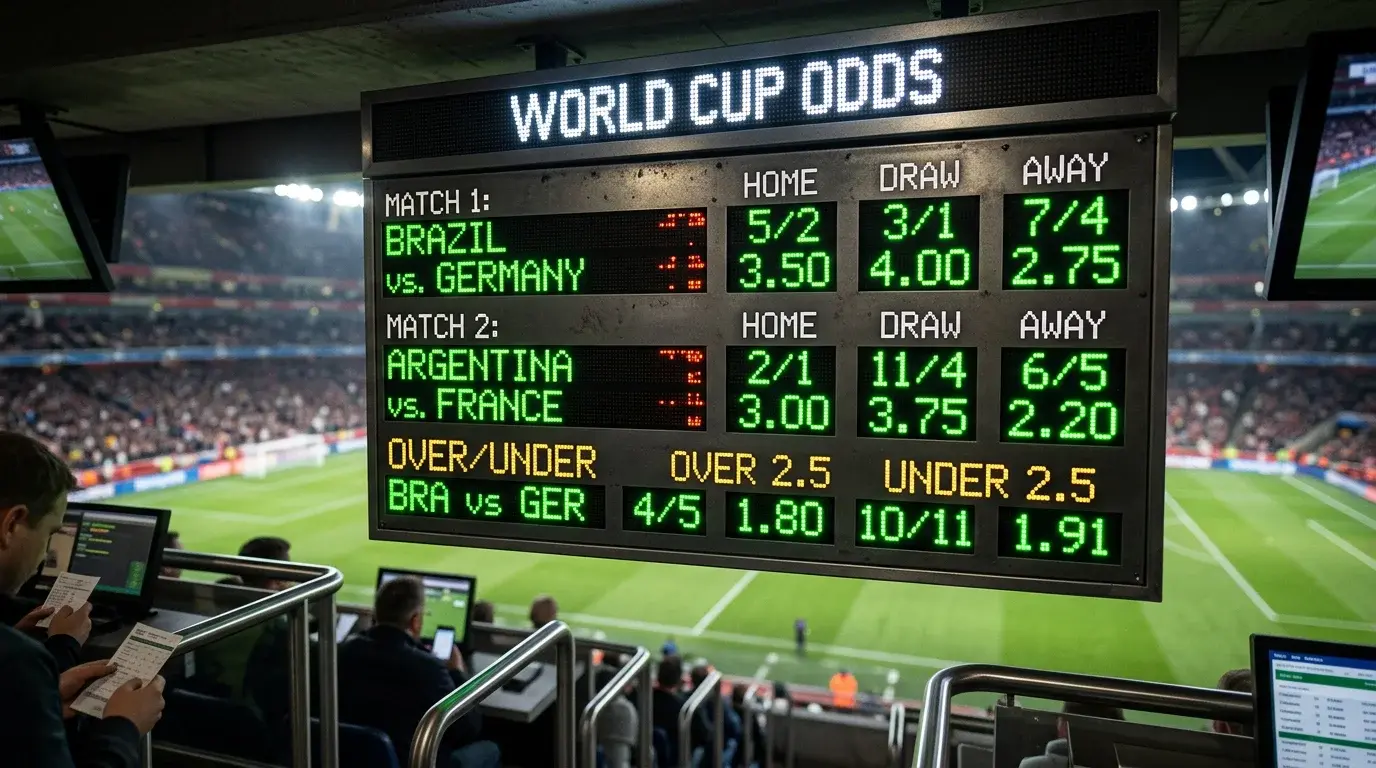
The format itself presents odds as a fraction: 5/1, 2/1, 11/8, 4/9, and so on. The first number tells you your profit relative to the second number, which represents your stake. At 5/1, a ten euro stake returns fifty euros in profit plus your original ten euro stake back, giving you sixty euros total. At 2/1, that same ten euros returns twenty euros profit plus your stake. The relationship between those two numbers describes the bookmaker’s assessment of probability and their margin combined into a single expression.
Short prices introduce the concept of odds-on betting, where the first number becomes smaller than the second. Brazil at 4/9 to beat Haiti means you need to stake nine euros to win four euros profit. These compressed prices reflect overwhelming favouritism but also demand larger stakes for meaningful returns. I have watched punters bankroll their entire World Cup budget on odds-on accumulators, convinced that stacking short prices reduces risk. The mathematics suggest otherwise: each leg multiplies probability against you regardless of how “certain” each selection appears.
Reading fractional odds fluently requires recognising common prices and their approximate probabilities. A 2/1 shot represents roughly a 33% chance when stripped of margin. Evens, expressed as 1/1, suggests approximately a 50% probability. The 5/1 outsider sits around 16.67% in true probability terms. These mental benchmarks allow you to scan a market rapidly and identify where the bookmaker sees genuine uncertainty versus consensus expectation.
The challenge with fractional odds lies in comparing prices that share no common denominator. Is 11/8 better or worse than 6/4? Both represent similar probability ranges, but quick mental calculation requires either converting to decimals or finding common ground mathematically. This friction explains why younger punters increasingly default to decimal format, where numerical comparison becomes straightforward. For the 2026 World Cup, you will encounter both formats across different bookmakers, and fluency in fractional remains essential for accessing the full range of Irish and British markets.
Decimal vs Fractional: When to Switch
A friend of mine who trades professionally told me that converting between formats should feel as natural as switching between kilometres and miles. After years of practice, I agree, but that naturalness only arrives through deliberate effort. Decimal odds dominate European exchanges and increasingly appear as the default setting on mobile apps targeting younger demographics. Understanding when each format serves you better transforms clunky mental arithmetic into fluid decision-making.
Decimal odds express your total return including stake per unit bet. At 3.50 decimal, a ten euro stake returns thirty-five euros total. At 1.44 decimal, that same ten returns fourteen euros and forty cents. The decimal figure directly multiplies your stake to produce your total return, making calculations instantaneous. Converting fractional to decimal requires adding one to the fraction: 5/1 becomes 6.00 decimal, 2/1 becomes 3.00, and 11/8 becomes 2.375. Moving the other direction subtracts one and expresses the result as a fraction.
I switch to decimal format when building accumulators. Multiplying decimal odds produces your accumulator’s combined decimal price immediately, while fractional accumulator calculation requires finding common denominators across multiple selections. A three-team acca at 2.00, 2.50, and 3.00 decimal multiplies to 15.00. In fractional terms, combining Evens, 6/4, and 2/1 requires converting each leg, multiplying, then potentially converting back. The friction discourages the kind of rapid price comparison that reveals genuine value.
Decimal format also excels when comparing prices across bookmakers. Seeing 3.25 versus 3.10 immediately communicates the gap, while 9/4 versus 21/10 requires conversion before meaningful comparison. For the World Cup outright markets, where odds range from 4.00 for favourites to 501.00 for minnows, decimal format provides instant readability across the entire spectrum.
However, fractional odds carry cultural weight in Ireland that extends beyond pure mathematics. Discussing Scotland at “fives” versus “nine-to-two” connects you to generations of punters who understood those phrases instantly. The communal aspect of betting, whether discussing odds in the pub or following tips from colleagues, often defaults to fractional shorthand. My approach involves thinking in decimals for calculation and conversion while speaking in fractional for communication. This bilingual fluency serves both analytical and social functions in Irish betting culture.
Implied Probability: The Hidden Truth
Every set of odds contains a probability estimate wearing a disguise. Stripping away that disguise reveals what the bookmaker actually believes about the likely outcome and exposes the margin they have built into every market. Implied probability transforms abstract numbers into concrete percentage chances, and understanding this conversion sits at the heart of finding value in World Cup betting.
Converting decimal odds to implied probability requires a simple formula: divide one hundred by the decimal price. At 4.00 decimal, the implied probability equals 25%. At 2.00, it becomes 50%. At 1.50, the market suggests a 66.67% chance. This calculation reveals the probability that would need to be true for the bet to break even over infinite repetitions, assuming no margin existed. Of course, margins always exist, which is precisely why understanding implied probability matters so much.
Bookmakers build their edge by inflating implied probabilities across every selection in a market. In a two-outcome market with true 50/50 probability, fair odds would be 2.00 on each selection. Instead, you typically see 1.91 or 1.95 on both sides, with the implied probabilities summing to more than 100%. This overround represents the bookmaker’s guaranteed profit margin regardless of outcome. For World Cup outright winner markets with 48 teams, the overround routinely exceeds 120%, meaning implied probabilities across all selections sum to 120% or more rather than the theoretical 100%.
Practical application involves calculating true probability and comparing it against the implied probability embedded in the offered odds. If I believe Scotland has a 25% chance of qualifying from Group C, and the bookmaker offers 3.50 on Scotland to qualify, their implied probability sits at 28.57%. My assessment suggests the odds should be higher, around 4.00, meaning no value exists at the current price. Conversely, if I believed Scotland’s true probability was 35%, that 3.50 price becomes attractive despite the margin because my expected probability exceeds the market’s assessment.
The 48-team World Cup format creates probability assessment challenges that the market has not fully priced yet. Historical data comes from 32-team tournaments with different qualification structures. The expanded format introduces more variables: more matches, more third-place qualifiers, more knockout round permutations. Bookmakers will rely heavily on historical patterns that may not translate cleanly, creating potential gaps between implied probability and true probability that attentive punters can exploit.
Finding Value: My Approach
The worst advice I ever received about betting came from someone who told me to follow my heart. Hearts know nothing about probability. Stomachs understand even less. Finding value requires systematic thinking that overrides emotional response, and developing this discipline represents the single greatest differentiator between recreational punters and those who extract consistent returns from the market.
My approach begins with independent assessment before checking any prices. For the World Cup, this means forming opinions about team quality, squad depth, managerial acumen, travel schedules, climate adaptation, and historical tournament performance without allowing bookmaker prices to anchor my thinking. If I believe Morocco genuinely threatens Brazil in Group C based on their 2022 World Cup trajectory and squad development, that assessment comes first. Only then do I check where the market has priced Morocco in relevant markets.
Value exists when my assessed probability exceeds the implied probability by a meaningful margin. The threshold varies with confidence. For assessments built on comprehensive analysis with multiple supporting data points, I might accept a 5% edge. For more speculative opinions, I require 10% or more before committing stake. This sliding threshold acknowledges that not all probability assessments carry equal reliability, and protecting against overconfidence requires baked-in conservatism.
Tracking results over time provides the feedback loop that validates or challenges your methodology. I maintain a spreadsheet recording every bet, my assessed probability, the implied probability at stake time, and the eventual outcome. Over hundreds of bets, patterns emerge. My assessments of group stage matches tend toward accuracy. My knockout round predictions carry systematic bias toward favourites. This data allows continuous refinement rather than relying on memory, which conveniently forgets losses and amplifies wins.
The World Cup specifically rewards punters who follow qualifying campaigns closely. Bookmakers set initial prices based on world rankings and historical reputation. Teams that improved dramatically during qualification, or those hiding weaknesses behind favourable qualifying groups, often carry mispriced odds entering the tournament. The gap between market perception and current reality creates value opportunities that evaporate once tournament action confirms or refutes the consensus.
World Cup Examples: Real Odds Decoded
Scotland at 33/1 to win the World Cup looks attractive to the emotional punter imagining a fairytale run. Converting to decimal gives us 34.00. The implied probability sits at 2.94%. For that price to represent value, Scotland would need better than a 3% true probability of lifting the trophy on July 19th. Given their group contains Brazil and Morocco, with potential knockout paths through multiple elite nations, assessing their true winning probability realistically lands somewhere between 0.5% and 1.5%. No value exists despite the appealing headline number.
Group C winner markets tell a different story. Brazil at 1/3 to top the group carries implied probability of 75%. Morocco at 4/1 implies roughly 20%, with Scotland at 8/1 suggesting 11% and Haiti at 50/1 assigned approximately 2%. These probabilities sum to 108%, revealing the bookmaker’s margin on this specific market. But do those assessments match reality? Morocco proved capable of beating elite opposition in Qatar 2022. Their implied 20% feels conservative given tactical quality and squad experience. Brazil’s 75% assumes dominance that one bad result could shatter.
Match betting for Scotland versus Haiti illustrates how to decode game-specific odds. Scotland at 2/7 carries implied probability of 77.78%. The draw at 4/1 implies 20%, and Haiti at 12/1 suggests 7.69%. Total implied probability reaches 105.47%, indicating a standard 5.47% overround on this market. My assessment places Scotland’s true winning probability higher than 77.78%, perhaps around 80-82%, but the margin already embedded in the price eliminates most potential value. The bet becomes fair at best rather than advantageous.
Top scorer markets demonstrate how implied probability changes across dozens of selections. Kylian Mbappé at 7/1 implies 12.5%. Vinícius Jr at 8/1 suggests 11.11%. Down the list, John McGinn might appear at 150/1, implying 0.66%. The entire market’s implied probabilities sum well above 100%, often reaching 130% or higher given the number of selections. Finding value requires identifying specific players whose true probability exceeds their implied figure, which typically means looking beyond the obvious favourites toward players whose tournament role or fixture difficulty the market has mispriced.
Which Format Serves You Better
After nine years of professional analysis, my settled view places decimal format ahead for pure calculation and fractional format ahead for cultural participation in Irish betting life. Neither format carries inherent superiority. What matters is developing fluency in both and applying each where its strengths align with your immediate task. For the World Cup specifically, building a framework that incorporates both formats will serve you better than committing exclusively to either.
Use decimal when building accumulators, comparing prices across multiple bookmakers, or conducting value analysis that requires precise implied probability calculation. The mathematical clarity accelerates decision-making and reduces error. Use fractional when discussing tips with friends, absorbing odds from traditional media coverage, or placing bets in retail betting shops where fractional remains the displayed default. This dual competency mirrors how many Irish professionals operate: technically sophisticated yet culturally grounded.
The World Cup odds explained in this guide provide the foundation, but application through practice transforms knowledge into skill. Start tracking your assessments now, before the tournament begins. Build confidence in probability estimation through the final qualifying matches and warm-up fixtures. By the time Mexico hosts the opening match against South Africa on June 11th, you will approach every market with the clarity that transforms confused punters into informed ones. That transformation began for me with a misunderstood 6/4 slip in 2006. Your starting point arrives today.
