

I still remember the moment I placed my first World Cup bet. France 1998, a tenner on Brazil to beat Scotland in the opening match of their group. Brazil won 2-1, I collected my modest profit, and something clicked. Twenty-eight years and nine tournaments later, I have watched the World Cup betting landscape transform from handwritten slips at the local bookies to live in-play markets updating every second on my phone. This summer’s tournament in the United States, Mexico, and Canada represents the most significant shift yet — 48 teams instead of 32, more matches than ever before, and betting opportunities that would have seemed impossible when I started.
This World Cup 2026 betting guide distils everything I have learned across nearly a decade of professional odds analysis. Whether you are a seasoned punter who has been backing teams since Italia 90 or someone placing their first football bet this June, the fundamentals I cover here will sharpen your approach. I am not selling you a system or promising guaranteed profits — anyone who does is lying. What I am offering is a framework built on data, pattern recognition, and hard-won lessons from tournaments past. The expanded format changes the game for everyone, and understanding those changes before kick-off gives you an edge the casual bettor will not have.
Throughout this guide, I will walk you through the new tournament structure, rank the betting markets by value potential, explain how to read odds in both fractional and decimal formats, share my personal bankroll management strategy using a realistic €100 budget, and highlight the mistakes that cost Irish punters money every four years. By the time you finish reading, you will have the knowledge to approach World Cup 2026 with confidence and discipline.
The 48-Team Format: My Take on the New Structure
FIFA doubled down on expansion, and I will be honest — my initial reaction was scepticism. More teams means more mismatches, more dead rubbers, more opportunities for the big nations to coast through early rounds. But after months of analysing qualification data and studying the draw, I have come around. The new format creates genuine betting opportunities that did not exist in the 32-team era, provided you understand the mechanics.
Here is how the tournament works: 48 teams split into 12 groups of four. The top two from each group advance automatically to the Round of 32, and the eight best third-placed teams join them. That last detail matters enormously. In the old format, finishing third typically meant elimination. Now, a single win and a draw might be enough to squeeze through. This changes team behaviour in the final group match — managers may rest key players knowing third place is likely safe, or they may push harder knowing goal difference could be the tiebreaker separating them from the eight lucky losers.
The numbers tell the story. With 104 matches across 39 days, punters face an average of nearly three games daily during the group stage. The old tournament gave us 64 matches; we are getting 40 more. That is 40 additional betting markets, 40 additional opportunities to find value, and 40 additional chances to make costly errors if you are not selective. I have seen punters burn through their entire bankroll chasing every match during a World Cup. The expanded format makes that trap even more dangerous.
Group stage dynamics shift fundamentally when eight third-placed teams progress. Consider a scenario: heading into matchday three, a team sits on three points with a goal difference of zero. In the old format, they would need to win or hope other results align perfectly. Now, they can calculate that three points will almost certainly be enough, since historical modelling suggests a third-placed team needs roughly four points to feel safe, and three points puts them in contention. This creates more conservative tactical approaches in some matches and more aggressive gambling in others.
From a betting perspective, I rate the new format positively for several reasons. First, the increased number of matches means more data points within the tournament itself. By the time the knockout rounds begin, we will have observed every team at least three times, including the minnows who previously had minimal exposure. Second, the third-place safety net encourages attacking football from teams that might otherwise park the bus. Teams chasing goal difference will open up, creating opportunities for over/under markets and both-teams-to-score bets. Third, the sheer volume of games creates inefficiencies. Bookmakers cannot devote equal attention to Curaçao versus Ivory Coast and Brazil versus Argentina. Sharp punters who research deeply can find edges in overlooked fixtures.
The host nation factor deserves attention too. With matches spread across the United States, Mexico, and Canada, travel distances become a variable. A team playing in Boston on matchday one and Miami on matchday two faces a 2,500-kilometre journey. Climate differences matter — Seattle’s mild summer versus Houston’s oppressive humidity affects player performance. I will be factoring venue sequencing into my pre-match analysis, and you should too. The bookmakers know about home advantage in traditional terms, but they may underweight the specific challenges of North American geography.
One word of caution: the expanded format increases variance. More teams means more first-time qualifiers with unknown tournament temperament. Haiti, Curaçao, and several others have never played World Cup football. How will their players handle the pressure? Historical form offers limited guidance when a nation has zero World Cup experience. I am building wider confidence intervals into my predictions for these matches, and I suggest you do the same. Backing a favourite at 1/5 looks safe until the underdog scores from their only corner and defends for 85 minutes.
Betting Markets Ranked: From Essential to Exotic
A colleague once told me that the World Cup is Christmas for bookmakers — everyone bets, even people who ignore football the rest of the year. That influx of casual money creates predictable patterns. The mainstream markets get hammered with public action, pushing odds on favourites to unfavourable levels, while specialist markets see less volume and more opportunity for those who understand them. I have ranked the major World Cup betting markets based on value potential and my personal track record.
The outright winner market sits at the heart of every World Cup. Backing Argentina at 5/1 or Brazil at 4/1 feels straightforward, but I rate this market 6/10 for value. The problem is juice — bookmakers build significant margins into outright markets because they know public money will pour in regardless. The true probability implied by the combined odds rarely matches reality. That said, I always place at least one outright bet because the entertainment value over six weeks is worth the potential loss. My approach is to identify one team whose odds feel genuinely mispriced relative to my assessment and stake conservatively. This tournament, I believe Morocco at 40/1 offers better value than their odds suggest based on their 2022 semi-final run and improved squad depth.
Match result markets form the bread and butter of World Cup betting, and I rate them 7/10 for value. The key is selectivity. I never bet every match. Instead, I identify fixtures where my assessment diverges significantly from the market. If bookmakers price a draw at 5/2 and my analysis suggests it should be closer to 2/1, that is a potential edge. Group stage matches involving evenly-matched mid-tier teams often offer better value than marquee fixtures because less public money distorts the lines. Scotland versus Morocco interests me far more from a betting standpoint than Brazil versus Argentina.
Over/under goals markets earn an 8/10 in my rankings because they sidestep the question of who wins. Predicting total goals requires different analysis — attacking quality, defensive organisation, referee tendencies, weather conditions, and tactical matchups. I find over 2.5 goals particularly interesting in matches between tournament newcomers and established nations. The newcomers often play open, naive football that creates high-scoring affairs. Conversely, under 2.5 becomes attractive when two defensively solid teams meet in a fixture where neither needs a win. The third matchday of the group stage historically produces lower-scoring games because teams manage risk.
Both teams to score sits at 7/10 for me. This market rewards understanding of defensive vulnerabilities. A team might be heavy favourites, but if they concede in 80% of their matches, both teams to score at even money looks tempting. The World Cup environment amplifies defensive errors — pressure, unfamiliar opponents, and fatigue all contribute. I track clean sheet percentages across qualifying campaigns and recent friendlies to inform my both-teams-to-score bets.
Asian handicap markets earn my highest rating at 9/10. The handicap eliminates the draw outcome by giving one team a virtual advantage or disadvantage. If you back Scotland at +1.5 against Brazil, you win if Scotland loses by one goal, draws, or wins outright. This market offers better value than match result because it forces more precise prediction. The half-goal increments remove ambiguity. I use Asian handicaps for most of my serious World Cup betting because the margins are typically tighter than traditional three-way markets.
Correct score markets tempt many punters but I rate them just 5/10. The odds look attractive — 10/1 for a 2-1 home win feels lucrative — but the difficulty of predicting exact scorelines makes these bets high-variance. I treat correct score as an occasional flutter rather than a core strategy. If I have a strong view on a match’s pattern — say, a tight defensive battle — I might back 1-0 or 0-0, but I never stake more than I would happily lose.
Player markets including top scorer, first goalscorer, and anytime goalscorer offer mixed value. The Golden Boot market sits at 6/10 because injuries and tournament variance create unpredictable outcomes. A striker who tears his hamstring in the quarter-final loses five potential matches. First goalscorer markets within a match can offer value if you identify set-piece specialists likely to score from early corners. Anytime goalscorer at reasonable odds on a penalty taker has logic behind it, though bookmakers price this in.

Specials and novelty markets earn a 4/10 from me. Will there be a red card in the final? Which manager gets sacked first? These are fun but fundamentally gambling rather than betting. The bookmaker edge on specials tends to be enormous because pricing obscure outcomes allows for wider margins. I might place a small novelty bet for entertainment, but it never forms part of my serious World Cup strategy.
Group winner and group qualification markets deserve attention at 8/10 value. These markets aggregate match outcomes into a single bet with longer odds than individual matches. If I believe Scotland will qualify from Group C, backing them at 5/4 to finish top two offers better expected value than betting on each match separately, assuming my probability assessment holds. The challenge is that group dynamics create dependencies — if Scotland beats Morocco, Morocco becomes more dangerous in their final match, affecting overall calculations.
Understanding Odds: Fractional, Decimal, and When to Use Each
I grew up reading odds as fractions because that is what every betting shop in Dublin displayed. 5/1 meant I would win five pounds for every pound staked. Simple enough. But the betting world has shifted, and decimal odds now dominate online platforms. Knowing how to read both formats — and convert between them mentally — makes you a sharper punter who can compare prices across bookmakers instantly.
Fractional odds express profit relative to stake. When you see 3/1, you win €3 for every €1 wagered, plus your stake back, totalling €4 returned. Odds of 1/3 mean you win €1 for every €3 staked — these are odds-on prices where the payout is less than double your stake. The terminology matters: odds of 11/10 are often called “eleven to ten against” while 10/11 is “ten to eleven on.” If you have spent any time in Irish bookmakers, this language feels natural.
Decimal odds show total return per unit staked, including your original stake. Odds of 4.00 mean a €1 bet returns €4 total — €3 profit plus €1 stake. This format simplifies calculation for accumulators because you multiply decimals directly. Three selections at 2.00, 1.50, and 3.00 give combined odds of 2.00 × 1.50 × 3.00 = 9.00. That same calculation in fractional form requires converting evens, 1/2, and 2/1 into a single fraction, which is tedious without a calculator.
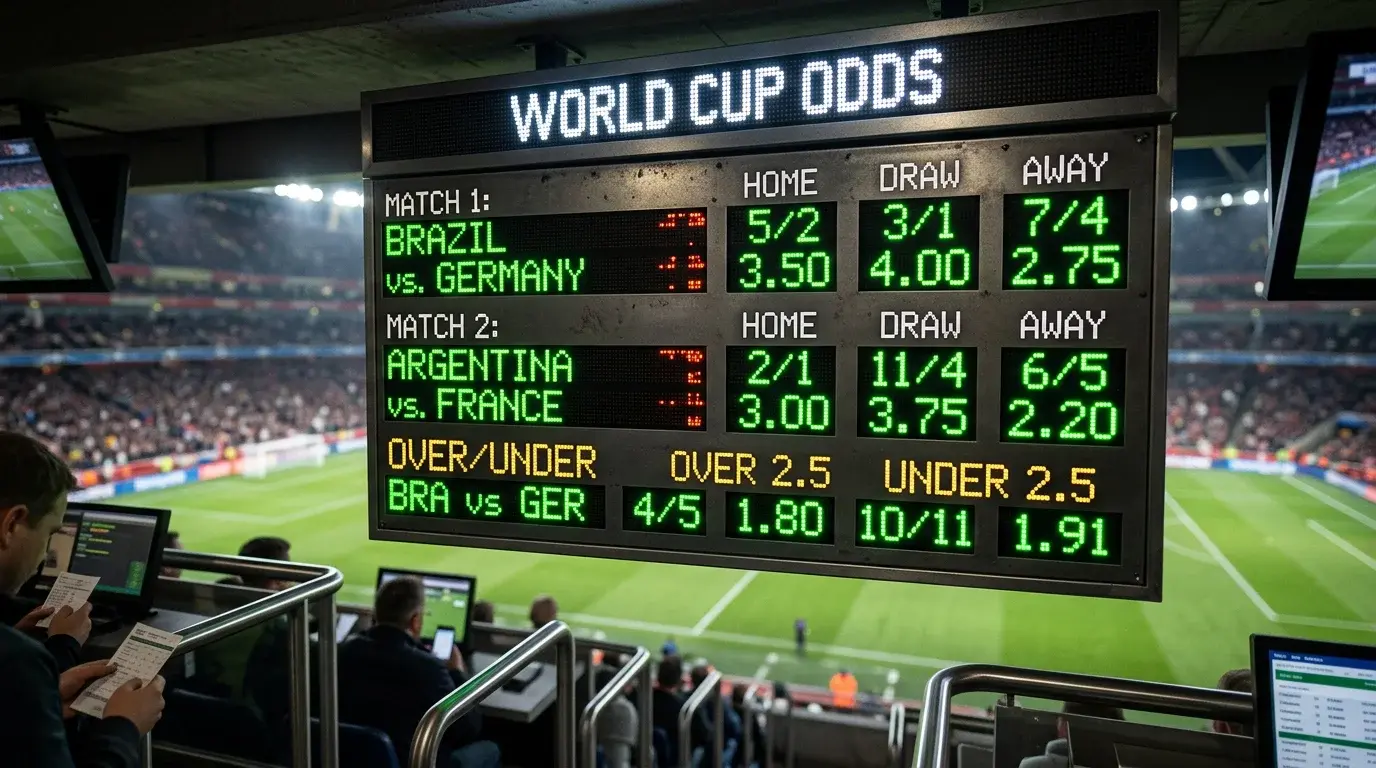
Converting between formats takes practice but becomes second nature. To turn fractional odds into decimal, divide the first number by the second and add one. So 5/2 becomes (5 ÷ 2) + 1 = 3.50 in decimal. To go the other way, subtract one from the decimal, then express as a fraction. Decimal 2.25 minus 1 equals 1.25, which is 5/4 in fractional terms. I run these conversions automatically now when comparing prices, and you should build the same habit.
The implied probability hidden in odds tells you the bookmaker’s assessment of likelihood. For fractional odds, divide the denominator by the sum of numerator and denominator. Odds of 3/1 imply 1 ÷ (3+1) = 25% probability. For decimal odds, divide 100 by the decimal. Odds of 4.00 imply 100 ÷ 4 = 25% probability. When the implied probability seems lower than your own assessment, you have identified potential value. If I think Scotland has a 30% chance to beat Morocco but the bookmaker prices them at 4.00 implying 25%, that is a mathematically attractive bet.
Which format should you use? I recommend setting your online accounts to decimal odds for calculation simplicity, especially when building accumulators or comparing prices across multiple bookmakers. The maths is cleaner. However, fractional odds remain valuable for intuitive understanding — “five to one” communicates something that “6.00” does not. When I discuss odds in conversation or analyse matches verbally, I think fractionally. When I calculate expected value or compare lines, I switch to decimal.
One subtlety many punters miss: the gap between fractional odds at certain price points obscures value differences. The jump from 9/4 to 5/2 looks small (2.25 to 2.50 in decimal) but represents an 11% difference in implied probability. That matters over hundreds of bets. I always price compare using decimal odds precisely because the linear scale makes differences clearer. If one bookmaker offers 3.40 and another offers 3.60 on the same outcome, the second represents 6% better value — obvious in decimal, harder to spot comparing 12/5 and 13/5.
The overround or juice built into odds deserves mention. Bookmakers do not offer fair odds — they shade every price slightly to guarantee profit. On a two-way market with true 50/50 odds, you would get 2.00 on each side. Instead, you might see 1.91 and 1.91, with the implied probabilities totalling 104.7% instead of 100%. That 4.7% is the bookmaker’s margin. Understanding overround helps you identify which bookmakers offer better value — lower overround means more favourable odds for punters. During World Cup 2026, I will be shopping lines aggressively because different bookmakers apply different margins to different markets.
Bankroll Strategy: My €100 World Cup Budget Plan
The best analysis in the world means nothing if you blow your bankroll in the first week. I have seen it happen dozens of times — a punter studies form for hours, identifies genuine edges, then stakes too aggressively and finds themselves watching the knockout rounds without any skin in the game. Bankroll management is not glamorous, but it separates long-term winners from recreational punters who complain about bad luck.
My recommendation for World Cup 2026 is to set aside a dedicated betting bankroll you can afford to lose entirely. Not money for rent, not savings for emergencies — genuine entertainment funds. For most Irish punters, I suggest starting with €100. This amount is significant enough to make wins feel meaningful while small enough that total loss does not create financial stress. If €100 feels like too much, halve it. If you are a high-volume bettor, scale up, but the principles remain identical.
I divide my World Cup bankroll into units. Each unit represents 1% of my starting bankroll — so with €100, one unit equals €1. This sounds small, but conservative staking is the entire point. My standard bet uses two units, meaning €2 per wager. For high-confidence plays where my edge seems substantial, I might go to three or four units maximum. I never stake more than 5% of my bankroll on a single bet regardless of confidence because even excellent bets lose regularly.
Let me walk through my €100 budget allocation for the tournament. I set aside €30 for outright and group winner markets before the tournament begins. These are pre-tournament bets with long odds that either pay handsomely or lose entirely. I place them and forget them. Another €50 goes to match betting during the group stage — this covers approximately 25 bets at €2 average stake. The remaining €20 reserves for knockout rounds when I have observed every team and refined my assessments. If I run hot during groups and my bankroll grows, I have more knockout ammunition. If I run cold, €20 still allows meaningful participation.
Tracking every bet matters enormously. I use a simple spreadsheet with columns for date, match, market, selection, odds, stake, and result. After each bet settles, I update the profit/loss column and running bankroll total. This habit reveals patterns invisible otherwise. You might discover you consistently lose money on certain markets or misjudge certain types of matches. Data does not lie, and tracking forces honest self-assessment.
The emotional discipline component separates professionals from amateurs. After a losing day, the temptation is to chase losses with larger stakes. After a winning day, overconfidence leads to reckless bets on marginal edges. My rule is simple: stake sizes depend on bankroll percentage and confidence level, never on recent results. If I lose five bets in a row, my next bet is still two units if my analysis suggests two-unit confidence. The previous losses are irrelevant to future probabilities.
One practical tip: withdraw profits during the tournament. If your €100 bankroll grows to €150 after the group stage, consider withdrawing €25 and playing the knockouts with €125. This locks in profit psychologically and prevents the common trap of losing back all your winnings plus your original stake. I know punters who turned €50 into €300 during group stages only to finish tournaments with nothing because they kept pressing. Partial withdrawals are good discipline.

Finally, accept that variance will frustrate you. Over 104 matches, you will suffer bad beats. Favourites will concede injury-time equalisers. 90th-minute penalties will flip results. Deserving teams will lose on fluke own goals. None of this reflects on your analysis quality. The test of good bankroll management is whether you can absorb these swings without deviating from your staking plan. If you are still solvent and disciplined entering the knockout rounds, you have managed your bankroll well regardless of profit or loss.
In-Play Betting: Where the Real Value Hides
The first time I watched odds move in real time during a match, I understood why sharp bettors treat in-play markets as their primary arena. Pre-match prices represent collective wisdom distilled over days of analysis. In-play prices react to information as it happens — and that reaction is often imperfect. A team scores an early goal, the match odds swing wildly, and suddenly the losing side at 6/1 looks generous if you believe the game will even out.
In-play betting during the World Cup presents unique opportunities because casual public money floods certain markets. When Brazil goes behind to an underdog, recreational punters pile onto Brazil to equalise, often pushing their odds below fair value. Conversely, when a favourite leads by one goal, the public assumes the match is over, and you can find value backing the trailing side at inflated prices. The key is having a model — even a rough mental model — for what the odds should be versus what bookmakers are offering.
My in-play strategy centres on pre-match preparation. Before any match I plan to bet live, I identify scenarios and my response. If Team A concedes first but I expect them to dominate possession, at what price does backing them become attractive? If the match reaches half-time goalless, do I expect goals in the second half or another 45 minutes of caution? Having these contingencies planned prevents reactive, emotional betting. When the scenario unfolds, I already know whether to bet and at what price threshold.
Certain in-play markets offer better value than others. The next goal market — betting on which team scores next or whether the match finishes goalless from that point — creates frequent opportunities. The over/under total goals market shifts constantly based on match state. If 60 minutes have passed with no goals, over 2.5 will offer longer odds than pre-match, but my assessment of remaining goal probability might suggest value. Corners and cards markets also move predictably: a team chasing a goal late throws players forward, creating corner opportunities and potential for desperate fouls.
Watching matches is non-negotiable for in-play betting. Odds react to events — goals, cards, injuries — but they cannot fully capture momentum shifts, tactical changes, or fitness levels visible only by watching. If a midfielder is limping but has not been substituted, the in-play prices will not reflect this until substitution happens. Your eyes tell you something the market does not know yet. During World Cup 2026, I will have multiple screens running: the match itself, live odds from two or three bookmakers, and a notepad for observations. This setup maximises information advantage.
The dangers of in-play betting deserve frank discussion. Speed matters, and hesitation costs money. If you spot value at 3.00 and delay ten seconds, the price might be 2.50 when you try to place. This pressure leads to rushed decisions and stakes placed without proper thought. I combat this by setting minimum price thresholds in advance. If I decide Team X becomes a bet at 4.00 or higher, I do not even consider betting below that price regardless of how the match unfolds. This removes urgency from decision-making.
Liquidity issues affect in-play markets on exchanges like Betfair differently than fixed-odds bookmakers. On exchanges, you might want to back at 5.00 but only €50 is available at that price. By the time larger liquidity appears, the price has moved. I factor liquidity into my in-play exchange betting, placing smaller stakes if necessary to guarantee execution. On fixed-odds platforms, the opposite problem emerges: bookmakers suspend markets briefly after significant events, and you cannot bet during the most volatile moments. Understanding these mechanics across platforms helps you position effectively.
One in-play tactic I use sparingly but effectively: cash out hedging. If I have a pre-match bet that looks likely to win — say, I backed the underdog and they lead 2-0 at half-time — I consider partial cash out or laying off on an exchange. This locks in guaranteed profit regardless of second-half outcomes. The pure expected value says to let winning bets run, but the guaranteed money has psychological value that keeps me disciplined for future bets. I view it as paying for emotional stability.
5 Mistakes That Cost Irish Punters Money
After nine years analysing betting patterns, I have catalogued the errors that separate winning punters from losing ones. These mistakes appear regardless of intelligence or football knowledge — they stem from psychological biases and emotional responses that affect everyone. Recognising them in yourself is the first step toward eliminating them from your World Cup betting.
The first and most costly mistake is favouring your heart over your head. Irish punters love backing Ireland, and with Ireland absent from this tournament, many will transfer that emotional investment to Scotland. Celtic brotherhood, shared history, the romance of supporting our neighbours — I feel it too. But emotion clouds judgment. I will bet on Scotland when the value exists and against them when it does not, regardless of who I want to win. Separating entertainment from analysis is essential. Cheer for Scotland in the pub; bet on probabilities at home.
The second mistake is chasing losses after a bad day. The psychology is understandable: you have lost €30, you feel frustrated, and the next match offers an apparent certainty that can recover your losses in one bet. So you stake €40 on a favourite at 1/4. The favourite stutters to a draw, and now you have lost €70. The chase continues until the bankroll disappears. My rule is absolute: stake sizes follow pre-determined percentages, and losing streaks do not justify deviation. If anything, a losing streak signals that my analysis might be flawed, requiring smaller stakes until I identify the problem.
Third, punters consistently overvalue recent form and undervalue base rates. A team wins their final warm-up friendly 4-0, and suddenly the public piles on them despite a decade of World Cup underperformance. Friendlies have minimal predictive value — managers experiment with lineups, players avoid injury risks, and neither team plays with tournament intensity. I weight competitive qualification matches far more heavily than any friendly result. The team that scraped through qualifying on goal difference is still the team that scraped through qualifying, regardless of their final tune-up results.
The fourth mistake is building reckless accumulators. A six-fold accumulator with each leg at evens pays 64/1 — the maths is seductive. But each additional leg multiplies your probability of losing. If each selection has a true 50% chance, a six-fold succeeds only 1.56% of the time. Most punters build accumulators with lower-probability selections, making success even rarer. I treat accumulators as entertainment bets with small stakes rather than serious investment vehicles. When I build accas, I limit them to three or four legs and ensure genuine value in each selection rather than chasing headline odds.
Fifth, punters neglect the importance of line shopping. Different bookmakers offer different prices on identical outcomes. Backing Brazil to beat Scotland at 1/6 with one bookmaker when another offers 1/5 throws away money over time. The difference seems small, but across dozens of World Cup bets, consistently taking worse prices costs significant expected value. I maintain accounts with multiple bookmakers specifically to compare lines before every bet. During World Cup 2026, I will check at least three prices before placing any wager. This habit takes seconds and pays dividends over the tournament.
One bonus mistake deserves mention: betting on matches you have not researched because they are on television. The mere availability of a match does not make it a betting opportunity. I skip many World Cup fixtures entirely because I lack the information edge to bet intelligently. Curaçao versus Ecuador might feature fascinating football, but if I know nothing about Curaçao’s starting eleven or tactical approach, I have no business wagering money. Selectivity is discipline, and discipline is profit.
Your World Cup Betting Checklist
The tournament begins on 11 June when Mexico faces South Africa at Estadio Azteca. By 19 July, one team will lift the trophy at MetLife Stadium in New Jersey. Those 39 days offer the most concentrated betting opportunity in football — more matches, more markets, and more chances to apply the principles I have outlined in this guide.
Before kick-off, complete these preparations: set your World Cup bankroll as a specific amount you can lose without financial stress. Open accounts with multiple bookmakers to enable line shopping. Decide your unit size — I recommend 1-2% of total bankroll for standard bets. Study the group compositions, particularly the third-place qualification dynamics. Identify which markets suit your analysis strengths. And honestly assess your emotional triggers — if Scotland losing would ruin your evening, do not bet on Scotland.
During the tournament, stick to your staking plan regardless of early results. Track every bet in a spreadsheet. Watch matches you plan to bet, and research teams before backing them in markets. Compare odds across bookmakers for every wager. Take partial profits if your bankroll grows significantly. And remember that the goal is informed entertainment, not guaranteed income. The punters who enjoy World Cup betting most are those who accept variance while maintaining discipline. Good luck this summer — I will be betting alongside you.
