

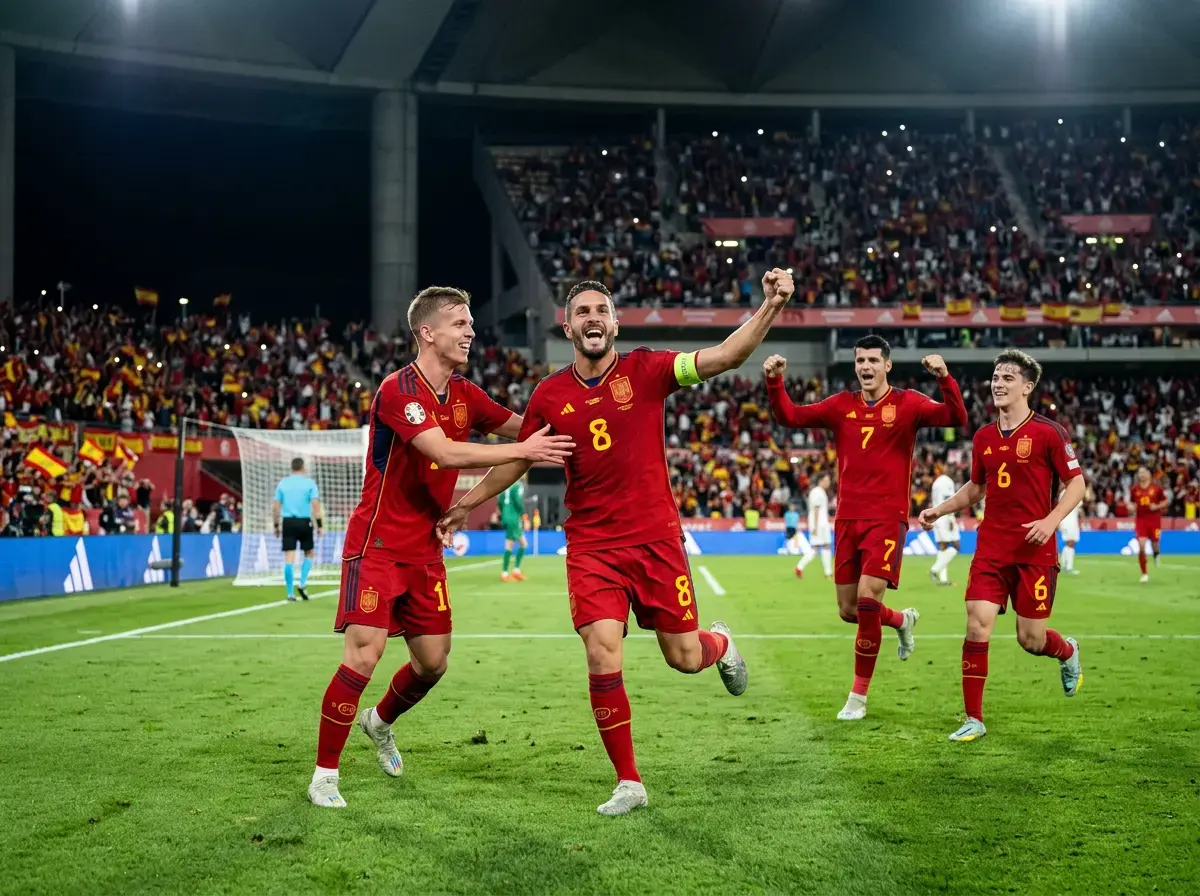
Berlin, 14 July 2024. Lamine Yamal — still just sixteen years old — danced past Kyle Walker and cut the ball back for Nico Williams to slam home the opening goal in the European Championship final. Minutes later, Mikel Oyarzabal sealed a 2-1 victory over England that delivered Spain’s fourth European title and announced a new generation of extraordinary talent. I watched that match in a Dublin pub filled with neutral supporters, and by the second half, everyone was cheering for Spain. The joy those young players radiated was infectious. Now, less than two years later, they arrive in America as reigning European champions with legitimate aspirations of completing the set.
Spain World Cup betting markets position La Roja among the genuine favourites, with outright odds of approximately 7/1 at most Irish bookmakers. That pricing reflects squad quality that spans generations — Yamal and Williams leading an attack that blends teenage brilliance with experienced heads like Álvaro Morata and Dani Olmo. Luis de la Fuente has built a team that plays the beautiful game without sacrificing competitive edge, combining the possession philosophy of Spanish tradition with directness that catches opponents unprepared. The question is whether teenage talents can sustain their form across a gruelling World Cup campaign.
I rate Spain as genuine value at current prices. The 7/1 odds imply approximately 12.5% probability of winning, which feels marginally pessimistic given the Euro 2024 triumph and the trajectory of their young stars. My value assessment sits at 8/10 — among the best in the tournament, better than Germany or England, comparable to France. Spain possess the perfect blend of youth and experience, tactical flexibility and technical quality, defensive solidity and attacking flair. The concerns around tournament fatigue and teenage inconsistency are valid, but the upside justifies the risk. If Yamal and Williams perform at their best, Spain are capable of beating anyone.
Squad Quality: Youth Meets Experience
Spanish football has always excelled at developing technical players through La Masia and other elite academies. The current generation represents the finest harvest in over a decade — talents who combine the traditional Spanish emphasis on possession and passing with physical qualities that previous generations lacked. De la Fuente has integrated these young players seamlessly alongside experienced heads, creating a balanced squad capable of adapting to any challenge.
Unai Simón provides reliable goalkeeping, his development at Athletic Club producing a shot-stopper comfortable with the ball at his feet. His distribution allows Spain to build from the back under pressure, while his reflexes have improved to elite levels following earlier career inconsistencies. David Raya offers world-class backup, his Arsenal experience making him among the strongest second-choice options in the tournament.
The defensive unit combines youth and experience effectively. Aymeric Laporte has returned to Spanish colours following his international switch, his passing range and positional awareness anchoring the backline. Alongside him, Robin Le Normand provides physical presence that Laporte sometimes lacks, while Pau Cubarsí — still just eighteen — represents the future with performances that belie his age. At right-back, Dani Carvajal continues despite advancing years, his Real Madrid experience invaluable in tournament football. Marc Cucurella provides width from the left, his attacking instincts balanced by improved defensive discipline.
Midfield is where Spanish tradition meets modern evolution. Rodri remains the anchor — a player of such intelligence and composure that opponents struggle to disrupt Spanish rhythm when he operates at his best. His absence through injury at the 2022 World Cup contributed significantly to Spain’s disappointing exit; his presence in 2026 transforms the entire team structure. Pedri provides the creative spark that unlocks defences, his passing combinations with forward players creating chances that other nations cannot replicate. Gavi adds energy and pressing intensity, his willingness to cover ground allowing more technical players to focus on attacking contributions.
The attack has been transformed by Lamine Yamal’s emergence. At eighteen, he plays with a fearlessness that experienced professionals cannot match. His dribbling ability creates one-on-one situations that favour Spain, while his crossing and shooting accuracy provide end product that justifies the hype. Nico Williams complements Yamal’s brilliance on the opposite flank, his directness and pace creating problems for any right-back. Álvaro Morata leads the line with intelligent movement and improved finishing, while Dani Olmo offers creativity from central positions. The depth extends to Ferran Torres, Mikel Oyarzabal, and young talents who would start for most other nations.
Group H Preview: Spain’s Path
Spain’s group draw produced opponents that should not threaten qualification but do offer varied challenges. Group H contains Saudi Arabia, Cape Verde, and Uruguay — a mix of Middle Eastern resources, African debut enthusiasm, and South American pedigree that Spain must navigate professionally.
Uruguay represent the primary opposition, their football tradition producing players capable of competing at the highest level. Darwin Núñez leads an attack that can trouble any defence, while Federico Valverde’s energy and quality in midfield makes him one of the tournament’s most complete players. Spain versus Uruguay has the potential for an entertaining group-stage encounter, with both sides possessing the technical quality to create chances. I expect Spain to win 2-1 or 2-0, with Uruguay providing genuine resistance before Spanish class tells.
Saudi Arabia return to the World Cup hoping to replicate their famous victory over Argentina in Qatar. That result remains one of the greatest upsets in tournament history, demonstrating that Saudi football has improved significantly in recent years. Their compact defensive approach and quick counter-attacks will test Spanish patience, particularly if the match remains tight. Spain should win 3-0 or 2-0, but the Saudi approach of frustrating elite opponents could make this fixture tighter than expected.
Cape Verde complete the group as debutants whose qualification represents a remarkable achievement for a nation of under 600,000 people. The gulf in quality favours Spain enormously, and this fixture offers De la Fuente an opportunity to rotate while still securing comfortable victory. A 4-0 or 5-0 scoreline seems likely, with second-string players given minutes to maintain sharpness.
The group-stage pathway should yield maximum points, positioning Spain as Group H winners. This places them in a favourable bracket for early knockout rounds, with genuine tests arriving in the quarter-finals or semi-finals. The path to the last eight looks navigable, which suits a young squad still developing tournament experience.
The American venues present interesting dynamics for Spanish players. Heat management becomes crucial in summer tournaments, and Spain’s possession-based style demands more running than direct approaches. De la Fuente’s preparation has included heat acclimatisation protocols, with training sessions scheduled to match expected match-day conditions. The coaching staff understand that young players require careful management across a long tournament — rotation through group stages preserves energy for knockout rounds where every match matters.
De la Fuente’s System: Evolution of Spanish Football
Luis de la Fuente’s appointment represented continuity rather than revolution. His methods — developed through successful youth team campaigns at Under-21 level — emphasised the traditional Spanish values of possession and passing while adding directness that previous regimes had lacked. The results speak for themselves: European Championship victory with a brand of football that excited neutral observers worldwide.
The base formation is a 4-3-3 that allows Yamal and Williams to operate as genuine wingers rather than inverted forwards. This shape provides width that stretches opposition defences, creating space for central players to exploit. Rodri anchors the midfield, his positional awareness allowing Pedri and Gavi to push forward into attacking positions. The full-backs provide overlapping support when required but prioritise defensive duties against stronger opponents.
Against weaker opposition, Spain dominate possession with patient buildup that waits for defensive mistakes. The movement of Yamal and Williams creates one-on-one situations that favour Spanish attackers, while Morata’s intelligent runs pin centre-backs and prevent them from stepping forward. The system produces consistent chances through combinations rather than individual brilliance, though individual brilliance remains available when needed.
Against stronger opponents, De la Fuente shows tactical flexibility. Spain can compress into a more defensive 4-5-1 when circumstances demand, with Yamal and Williams dropping to provide midfield numbers. This adaptability — absent from the rigid systems of previous Spanish regimes — makes La Roja harder to prepare for. Opponents cannot assume Spain will dominate possession; they must account for the direct threat of Williams’ pace and Yamal’s creativity even when defending leads.
Key Players: Yamal, Williams & The Wonder Kids
Lamine Yamal represents something extraordinary in modern football. At sixteen, he started a European Championship final. At seventeen, he became the youngest scorer in tournament history. At eighteen, he arrives at the World Cup as one of the most feared attackers in football, his ability to beat defenders and create chances making him unplayable on his best days. The comparisons to Messi are inevitable and not entirely unfair — Yamal possesses the same low centre of gravity, close control, and ability to produce magic from minimal space.
What separates Yamal from other prodigies is his composure in high-pressure situations. The Euro 2024 final goal against England demonstrated maturity that players twice his age cannot match. He does not wilt under pressure; he embraces it. His decision-making in tight spaces suggests an intelligence that supplements his natural talent, making him difficult to contain even when opponents know exactly what he wants to do. For Spain, Yamal operates as the primary creative threat, the player around whom attacking play revolves.
Nico Williams provides the perfect complement to Yamal’s brilliance. Where Yamal beats defenders through close control and feints, Williams destroys them with pace and power. His directness creates problems that even elite right-backs struggle to solve, while his end product — goals and assists in equal measure — justifies his status as a starting player rather than mere squad option. The partnership between Yamal and Williams has drawn comparisons to historic Spanish attacking duos, though their styles differ from the more cerebral approaches of Villa and Iniesta.
Rodri anchors everything Spain do. The Manchester City midfielder controls tempo with an authority that makes Spanish possession football function. His passing accuracy exceeds 93% in competitive matches, while his positional awareness allows him to intercept opposition attacks before they develop. Without Rodri, Spain lost direction at the 2022 World Cup; with him, they dominate matches through midfield superiority that few nations can match.
Pedri operates as the creative link between midfield and attack. His vision and passing range unlock defences that other players cannot penetrate, while his work rate off the ball ensures Spain maintain pressure when not in possession. The Barcelona midfielder has matured significantly since his breakthrough at Euro 2020, adding physical resilience to technical excellence that makes him a complete midfielder. His partnership with Gavi creates midfield combinations that opponents struggle to track, with both players capable of arriving late in the box to convert chances.
The supporting cast extends the quality throughout the squad. Dani Olmo provides creativity from central positions, his ability to play as a false nine or attacking midfielder giving De la Fuente tactical options that previous Spanish managers lacked. Ferran Torres offers pace and directness from wide positions, his movement and finishing providing alternatives when Yamal and Williams require rest. Mikel Oyarzabal’s Euro 2024 final goal demonstrated the depth available — players capable of decisive contributions from the bench when matches hang in the balance.
Betting Analysis: Euro Champions Value?
Spain at 7/1 implies approximately 12.5% probability of winning the tournament. This pricing feels marginally pessimistic given their Euro 2024 triumph and the quality of their young attacking players. My assessment places Spain’s true probability closer to 15%, making current odds attractive for value-seekers willing to back reigning European champions.
My value rating for Spain outright sits at 8/10 — among the highest in the tournament, better than Germany or Brazil, comparable to Argentina. The Yamal-Williams partnership provides attacking quality that rivals any nation, while Rodri’s presence in midfield addresses the control issues that characterised their 2022 exit. I would recommend modest stakes on Spain outright at 7/1 for those seeking genuine value with significant upside potential.
Spain to reach the final is available at approximately 11/4, implying 27% probability. I rate this 8/10 for value — the group draw facilitates comfortable qualification, and the bracket should open favourably through early knockout rounds. The semi-final represents the meaningful hurdle, where Spain will likely face Argentina, France, or Brazil. Backing them to reach the final makes sense given their Euro 2024 performance.
Yamal for Golden Boot deserves serious consideration at 16/1. His goal threat from wide positions creates opportunities, while Spain’s expected deep run provides chances for accumulation. The competition from Mbappé, Kane, and Vinícius keeps odds attractive, while Yamal’s form suggests he can contend despite his youth. I rate this 7/10 — genuine value for a player capable of decisive tournament performances.
Team totals offer interesting angles. Spain over 8.5 tournament goals is available at approximately 6/5, implying they need to average 2.8 goals across minimum three matches. In qualification and Euro 2024, Spain averaged 2.9 goals per match — right on target for this total. I rate the over at 7/10 — reasonable odds for a team whose attacking quality supports consistent goalscoring.
My Verdict: La Roja’s Golden Kids
Spain possess everything required to win World Cup 2026. Yamal and Williams provide attacking quality that rivals anyone in world football. Rodri’s midfield control allows Spanish possession football to function at its best. De la Fuente’s tactical flexibility addresses the rigidity that characterised previous regimes. And the psychological boost from Euro 2024 — winning a major tournament with this young squad — provides confidence that money cannot buy.
The Euro 2024 experience shapes everything about Spain’s World Cup approach. Those young players know what it takes to win knockout matches against elite opposition. They have experienced the pressure of finals and emerged victorious. Yamal’s composure, Williams’ directness, Pedri’s control — these qualities were tested against England and Germany before proving decisive against England in the final. Tournament experience at this level cannot be replicated in training or preparation matches; it must be earned through competitive football. This Spanish squad has earned it.
The youth question remains the primary concern. Yamal will be eighteen during the tournament; Williams twenty-three; Pedri twenty-three; Gavi twenty-one. This core has limited experience of the physical and mental demands of World Cup campaigns. Can teenagers sustain their form across seven matches in American summer heat? The Euro 2024 experience suggests yes, but the World Cup presents a different challenge — more matches, longer tournament, greater pressure. De la Fuente must manage workloads carefully to ensure his young stars remain fresh for knockout rounds.
The defensive solidity deserves recognition alongside the attacking brilliance. Spain conceded just four goals across seven matches at Euro 2024, with Rodri’s screening allowing the back four to focus on their primary duties. Laporte’s experience combines with younger players’ athleticism to create a balanced defensive unit. This solidity matters in knockout football, where single goals often prove decisive.
My prediction places Spain in the semi-finals, where I expect them to face Argentina or France in a match that could define the tournament. Whether they progress depends on margins impossible to predict: individual brilliance, refereeing decisions, the stamina of young players across gruelling knockout rounds. What I can say with confidence is that Spain will be competitive against any opponent. Euro 2024 was not a fluke — this generation has genuine quality.
For betting purposes, I recommend Spain to reach the final at 11/4 as the primary wager. This captures their quality while acknowledging the potential for semi-final exits against elite opposition. Supplement with Yamal for Golden Boot at 16/1 for individual exposure. And consider stakes on Spain outright at 7/1 — among the best value in the tournament for those willing to back youth over experience.
