

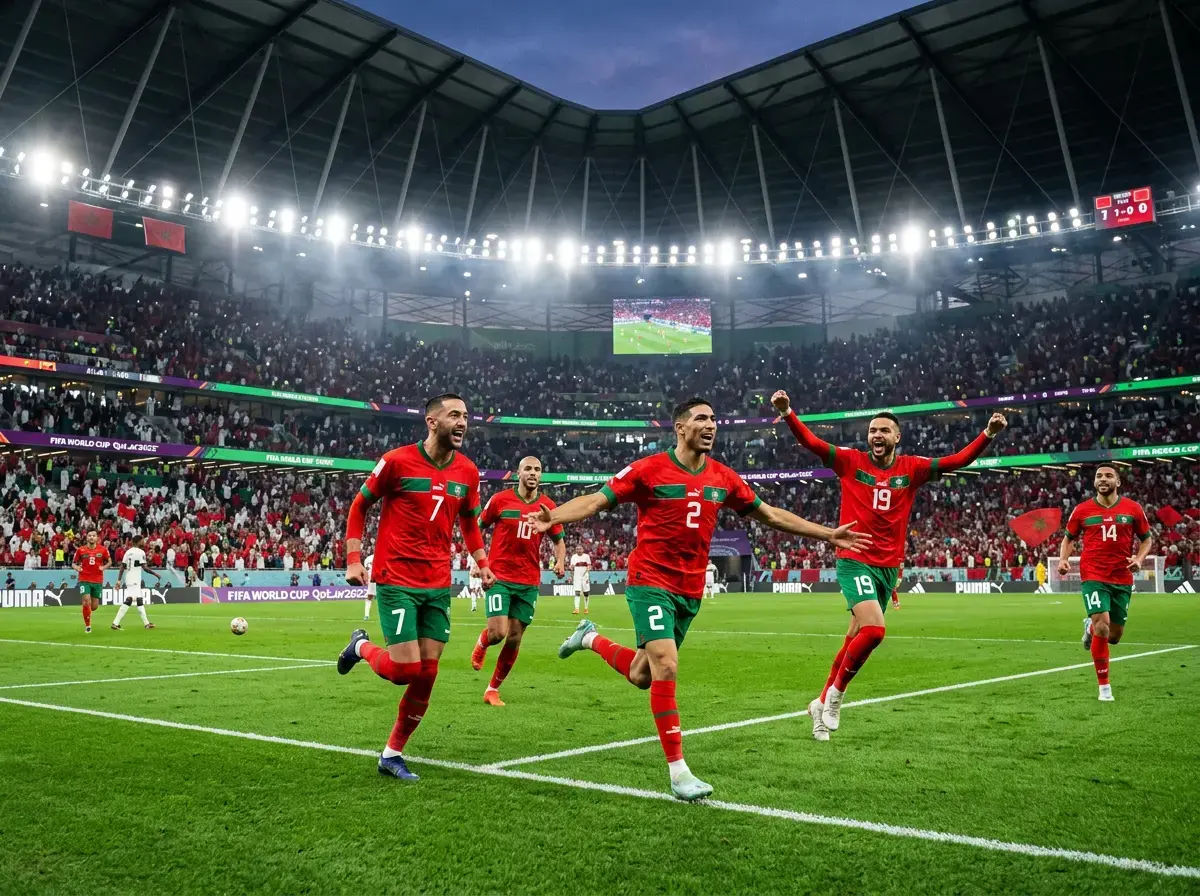
Al Bayt Stadium, December 2022. Morocco had just eliminated Portugal to reach the World Cup semi-finals — the first African nation ever to achieve that feat. The images of Achraf Hakimi sliding on his knees, of Walid Regragui embracing his players, of an entire continent celebrating through the night, remain vivid in football’s collective memory. I watched that match in a Dublin pub that had somehow filled with Moroccan supporters, their joy infectious and absolute. That tournament run was not a fluke — Morocco outplayed Spain and Portugal through tactical discipline and collective spirit that suggested a new African football power had emerged. Now they return to test whether Qatar was a breakthrough or a one-off wonder.
Morocco World Cup betting markets position the Atlas Lions as genuine dark horses at approximately 25/1 for outright victory. That pricing reflects both respect for their Qatar achievement and recognition that repeating such success demands sustained excellence. The squad has evolved since 2022, with some heroes ageing out while younger talents emerge to take their places. Regragui remains in charge, his pragmatic approach now refined through additional experience. The group draw places Morocco alongside Brazil, Scotland, and Haiti in Group C — a challenging assignment that will immediately test whether they can perform at their previous level.
I rate Morocco as interesting value at current prices. The 25/1 odds imply roughly 4% probability of winning, which feels marginally pessimistic given their demonstrated ability to eliminate elite nations. My value assessment sits at 6/10 — not a primary recommendation, but worth consideration for punters seeking longer-odds exposure with genuine upside. Morocco’s ceiling remains unclear; their floor involves comfortable group qualification ahead of Scotland and Haiti. The risk-reward profile suits punters willing to accept uncertainty in pursuit of substantial returns.
Squad Overview: Evolution Since Qatar
The Morocco squad has undergone natural evolution since their historic 2022 run. Some veterans have retired or declined, while younger players have emerged to claim starting positions. The overall quality remains high, though whether it matches the peak achieved in Qatar requires tournament validation.
Yassine Bounou continues as first-choice goalkeeper, his performances in Qatar earning recognition as one of the tournament’s outstanding players. The Sevilla shot-stopper combines excellent reflexes with commanding presence, his ability to organise the defence contributing to Moroccan defensive solidity. Behind him, Munir El Kajoui provides reliable backup that most nations would envy. Bounou’s penalty saves against Spain remain among the defining moments of the 2022 tournament, and his experience under pressure will prove invaluable against elite opposition.
The defensive unit has maintained its structure despite personnel changes. Achraf Hakimi remains world-class at right-back, his pace and attacking instincts creating overloads that opponents struggle to contain. The Paris Saint-Germain defender has matured since Qatar, adding defensive discipline to his already exceptional attacking contributions. Nayef Aguerd and Romain Saïss provide central defensive experience, though both have aged since Qatar and their pace has declined accordingly. Noussair Mazraoui offers versatility across the backline, his Bayern Munich experience adding another dimension to Moroccan defensive options. The defensive organisation that frustrated Spain and Portugal remains Regragui’s foundation.
Midfield has seen the most significant evolution. Sofyan Amrabat’s star rose dramatically after Qatar, his tireless running and tactical intelligence attracting interest from elite European clubs. The Manchester United midfielder covers ground that allows more creative teammates to take risks, his screening ability protecting the back four during opposition attacks. Azzedine Ounahi emerged as a creative force during the tournament, his passing and movement unlocking defences that expected Moroccan conservatism. The midfield balance between defensive discipline and attacking contribution defines Regragui’s approach — Morocco absorb pressure without sacrificing counter-attacking threat.
The attack features Hakim Ziyech’s creativity alongside Sofiane Boufal’s directness. Both players can produce moments of magic that decide tight matches, though consistency has sometimes eluded them at club level. Ziyech’s set-piece delivery provides Morocco with dangerous opportunities from free kicks and corners, while his ability to find pockets of space creates chances for teammates. Youssef En-Nesyri leads the line with physical presence and aerial threat, his movement creating space for teammates to exploit. The attacking depth allows Regragui to adjust his approach depending on opposition quality and match situation.
Group C Preview: The Challenge Ahead
Morocco’s Group C assignment presents immediate challenges that will determine whether their Qatar success can be replicated. Brazil represent the benchmark — five-time champions whose quality exceeds anything Morocco faced en route to the 2022 semi-finals. Scotland provide a test of consistency against a well-organised European side. Haiti should offer three points that Morocco must secure to maintain qualification hopes.
The Brazil fixture defines Morocco’s group-stage ceiling. A positive result against the Seleção would announce Morocco as genuine contenders; defeat would not eliminate them but would clarify the quality gap they must overcome. Regragui’s defensive organisation succeeded against Spain and Portugal, but Brazil’s attacking quality — Vinícius Jr, Rodrygo, Raphinha — presents different challenges. The match profile will likely feature Moroccan defensive discipline against Brazilian technical superiority, with fine margins determining the outcome.
Scotland represent a genuine test where Morocco should be favourites but cannot assume victory. Steve Clarke’s side possess quality through McTominay, Robertson, and McGinn that demands respect. The tactical battle between Regragui’s pragmatism and Clarke’s defensive solidity could produce a tight, low-scoring encounter. Morocco need at least a draw here to maintain comfortable qualification trajectory.
Haiti should provide three points that Morocco must secure without complication. The CONCACAF qualifiers lack the individual quality to threaten Moroccan progression, though any complacency could create problems. A professional victory by two or three goals represents the expected outcome, with Regragui likely rotating his squad to preserve key players for more demanding fixtures.
The qualification pathway looks favourable despite the Brazil challenge. Second place in Group C seems achievable, setting up a Round of 32 fixture against a third-placed team from Groups A, B, or D. That bracket position offers opportunity for further progression without immediately facing another elite nation.
Key Players: The Morocco Core
Achraf Hakimi stands as Morocco’s most important player. His ability to influence matches from right-back exceeds what most defenders can offer — pace to beat opponents, crossing quality to create chances, and defensive awareness that has matured since his breakthrough at Real Madrid. Hakimi’s overlapping runs stretch opposition defences, creating space for Ziyech and Ounahi to exploit centrally. When Morocco build attacks, Hakimi often provides the final ball.
Sofyan Amrabat’s role may be less glamorous but remains equally essential. His tireless running screens the defence, recovers possession in dangerous areas, and allows Morocco to defend with fewer players while maintaining attacking threat. The 2022 tournament showcased his ability to perform at the highest level — his performance against Spain remains among the best individual midfield displays in World Cup history.
Hakim Ziyech provides the creative spark that Morocco require in tight matches. His ability to produce moments of magic — incisive passes, curling shots, dangerous free kicks — can decide fixtures that tactical discipline alone cannot win. At 33, this may be his final major tournament, and the motivation to add World Cup success to his career honours should drive peak performances.
Betting Analysis: Value Assessment
Morocco at 25/1 for outright victory offers speculative value for punters who believe the Qatar run represented genuine quality rather than fortunate circumstances. The odds imply 4% probability, which I consider marginally pessimistic given their demonstrated ability to eliminate elite opposition. However, repeating that success requires sustained excellence across seven matches, which represents a higher bar than single knockout victories.
The market has priced Morocco conservatively following their Qatar success, suggesting bookmakers believe the 2022 run involved fortune that cannot be replicated. This assessment seems reasonable but potentially underestimates the systematic quality Regragui has built. Morocco are not a collection of overperforming individuals — they are a genuinely well-organised team with clear tactical identity.
Morocco to reach the quarter-finals at approximately 7/2 provides better risk-reward for most punters. This requires winning Group C or finishing second and then winning a Round of 32 match — achievable targets given their quality. The quarter-final represents where Morocco’s 2022 journey truly became historic; backing them to reach that stage again offers reasonable odds for realistic outcomes.
Morocco to qualify from Group C at approximately 4/5 represents the safest entry point. The pricing implies 56% probability, which I consider slightly pessimistic. Morocco should beat Haiti comfortably and compete strongly with Scotland, making qualification likely even if they lose to Brazil. I rate this market at 7/10 for value. The group stage offers Morocco’s clearest path to returns.
Morocco to finish second in Group C at 11/8 offers interesting angles. This requires finishing ahead of Scotland while behind Brazil — a probable outcome given relative squad qualities. The pricing feels reasonable, though I prefer the simpler qualification market for most punters.
My Verdict: Realistic Expectations
Morocco proved in Qatar that African football can compete at the highest level. Their tactical discipline, collective spirit, and individual quality combined to produce results that exceeded all expectations. The question for 2026 is whether they can replicate that performance against similarly challenging opposition.
The 2022 run benefited from circumstances that may not repeat. The knockout path avoided the very strongest nations until the semi-finals, where France proved too strong. The element of surprise — opponents unfamiliar with Moroccan methods — has dissipated now that every coach has studied Regragui’s approach. Replicating that success requires Morocco to be even better than they were in Qatar, which demands improvement from an already excellent foundation.
The generational factor deserves consideration. Several key players from 2022 have aged, with peak years behind them. Ziyech at 33, Saïss at 35, and other veterans may not sustain their Qatar form across another demanding tournament. The younger players who emerged — Ounahi, for example — must continue their development under tournament pressure. The balance between experience and athleticism will determine Morocco’s ceiling.
My prediction places Morocco in the Round of 16, where I expect them to face a Group D winner — potentially USA or Turkey. That match represents a winnable fixture that could extend their tournament. The quarter-finals remain achievable if brackets align favourably, though progression beyond requires everything to align as it did in Qatar. Reaching the semi-finals again would require exceptional fortune alongside sustained excellence.
For betting purposes, I recommend Morocco to qualify from Group C at 4/5 as the primary wager. This captures their quality while avoiding the uncertainty of knockout progression. Supplement with Morocco to reach the quarter-finals at 7/2 for those seeking longer-odds exposure. Avoid outright winner bets unless prices drift significantly beyond 30/1. The value lies in backing Moroccan quality against achievable targets rather than speculating on exceptional outcomes.
