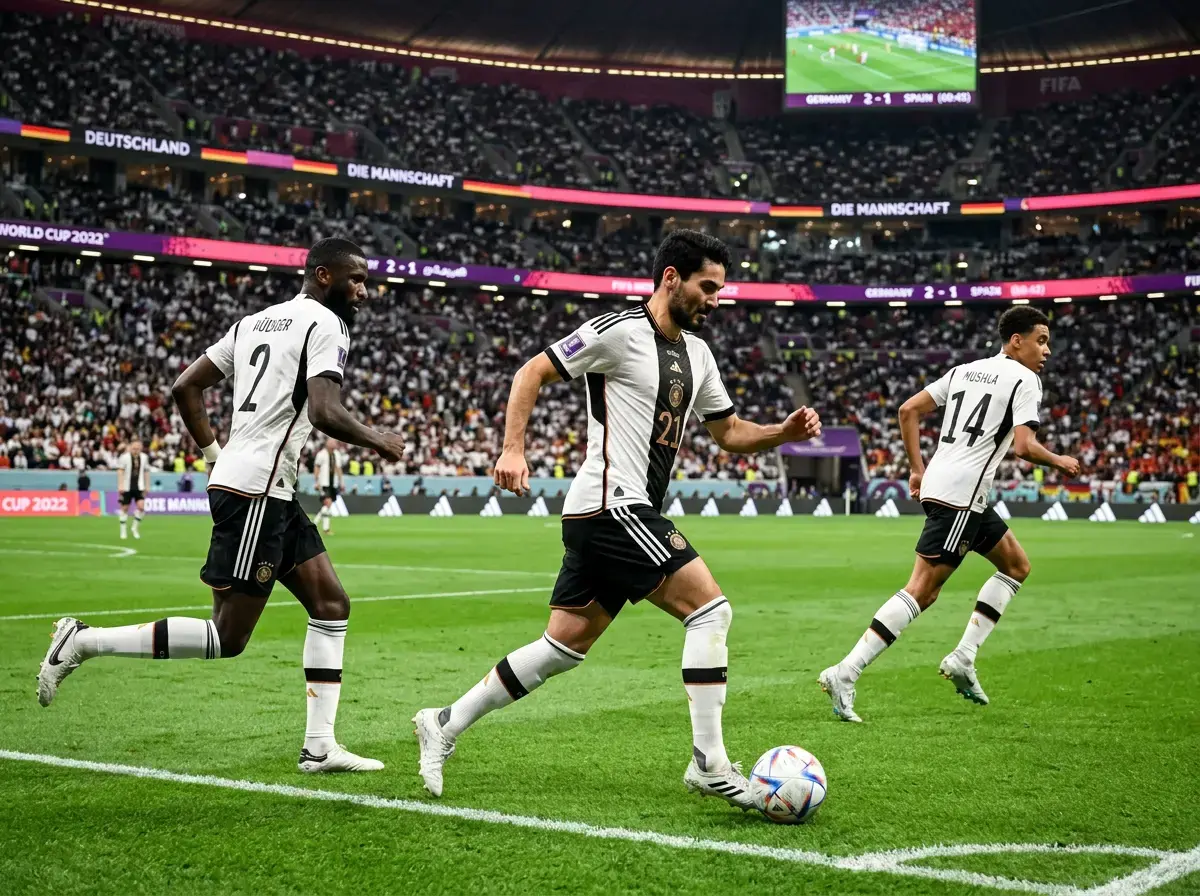
German football knows how to rebuild. After the humiliation of group-stage exits at the 2018 and 2022 World Cups — performances that would have seemed unthinkable during their dominant years — Die Mannschaft have undergone a generational transformation that restored them to genuine contender status. Euro 2024 on home soil delivered the catalyst: a tournament where Jamal Musiala and Florian Wirtz announced themselves as world-class talents, where the weight of expectation finally felt like motivation rather than burden, where Germany remembered how to compete at the highest level. They fell in the quarter-finals to Spain, but the manner of performance suggested a team ready to challenge again. Now they arrive in America with legitimate aspirations of adding a fifth World Cup star to their famous jersey.
Germany World Cup betting markets reflect this transformation. Odds of approximately 8/1 place them among the second tier of contenders, behind Argentina, France, and Brazil but ahead of most European rivals. The pricing acknowledges both the squad quality — Musiala and Wirtz form perhaps the most exciting young attacking partnership in world football — and the uncertainty that accompanies any team emerging from a rebuilding phase. Julian Nagelsmann’s appointment has brought tactical innovation and attacking intent that previous managers lacked, but his tournament inexperience raises questions about pressure-moment management.
I rate Germany as genuine value at current prices. The 8/1 odds imply approximately 11% probability of winning, which feels marginally pessimistic given the trajectory since Euro 2024. My value assessment sits at 7/10 — comparable to France, better than Brazil, slightly behind Argentina. Germany possess the attacking quality to beat anyone on their day, and Nagelsmann’s tactical flexibility addresses the rigidity that characterised their worst tournament performances. The risk lies in defensive vulnerabilities that elite opponents will target, and in the pressure of carrying German expectations into knockout matches. If those concerns prove manageable, 8/1 represents excellent value for four-time champions.
Golden Generation 2.0: Squad Assessment
The German football academy system continues to produce world-class talents at a rate that other nations envy. Bayern Munich, Borussia Dortmund, and RB Leipzig have invested heavily in youth development, and the results are visible throughout the current squad. Where the 2018 and 2022 squads relied on ageing players past their peak, this team features hungry young talents ready to establish themselves on the global stage.
Manuel Neuer remains the first-choice goalkeeper despite his advancing years. The Bayern Munich captain brings experience and shot-stopping ability that justify his selection, though his distribution has declined from the sweeper-keeper peak of previous generations. Marc-André ter Stegen provides world-class backup, his Barcelona experience making him among the strongest second-choice goalkeepers in the tournament.
The defensive unit has stabilised under Nagelsmann’s guidance. Antonio Rüdiger anchors the backline with the physical presence and leadership that made him essential to Real Madrid’s Champions League victories. His partnership with Jonathan Tah has developed chemistry, with Tah’s composure complementing Rüdiger’s aggression. At right-back, Joshua Kimmich provides multi-positional flexibility — capable of operating in midfield or defence depending on tactical requirements. The left-back position features David Raum, whose attacking instincts and crossing ability make Germany dangerous from wide areas.
Midfield is where German transformation becomes most visible. Florian Wirtz has emerged as one of Europe’s elite creative players, his technical quality and vision unlocking organised defences with passes that other players cannot conceive. At just 22, he has already accumulated more Bundesliga assists than most players manage in entire careers. Alongside him, Robert Andrich provides the defensive screening that allows Wirtz to focus on attacking contributions, his positional awareness and tackling ability stabilising the central areas.
The attack features Jamal Musiala, whose dancing dribbling style and finishing ability have drawn comparisons to Lionel Messi. Such comparisons are premature but not unreasonable — Musiala possesses the low centre of gravity and close control that allow him to navigate through tight spaces where other players would lose possession. His partnership with Wirtz creates overloads that opponents struggle to contain, with both players capable of scoring or creating depending on match situations. Kai Havertz leads the line with intelligent movement and improving finishing, his Arsenal experience adding the edge that was missing during difficult Chelsea years. The depth extends to Leroy Sané, Serge Gnabry, and emerging talents who would start for most other nations.
The generational transition extends throughout the squad. Where Germany’s 2018 and 2022 campaigns relied on veterans past their peak — Müller, Kroos, Hummels — this squad features players entering their prime years with genuine hunger for success. Musiala, Wirtz, Havertz, and Tah represent a core that could dominate German football for the next decade, while the supporting cast includes proven performers and emerging talents in appropriate balance. This generational refresh explains the optimism surrounding German football despite the humiliations of recent tournaments.
Group E Preview: Germany’s Path
Germany’s group draw produced opponents that should not threaten qualification but do offer interesting challenges. Group E contains Côte d’Ivoire, Ecuador, and Curaçao — a mix of African quality, South American competitiveness, and debutant enthusiasm that Germany must navigate professionally.
Côte d’Ivoire represent the primary opposition, their Africa Cup of Nations victory in 2024 demonstrating the quality that makes them dangerous against anyone. Sébastien Haller’s return from illness has provided a focal point for their attack, while Nicolas Pépé and Wilfried Zaha offer wide options capable of moments of individual brilliance. The Elephants will test German defensive organisation, particularly in transition where their pace creates difficult decisions for centre-backs. I expect Germany to win 2-1 or 3-1, with Côte d’Ivoire providing genuine resistance before class tells.
Ecuador bring South American organisation and fighting spirit that makes them difficult to overcome comfortably. Their qualification through a competitive CONMEBOL campaign included victories against Argentina and Brazil, demonstrating they can trouble elite opposition. Moisés Caicedo’s presence in midfield provides quality that rivals any German midfielder, while Enner Valencia’s experience ensures their attack remains functional. Germany should win this match 2-0 or 1-0, with patience required to break down a stubborn Ecuadorian defence.
Curaçao complete the group as the weakest side, their qualification representing a remarkable achievement for a nation of under 200,000 people. The gulf in quality favours Germany enormously, and this fixture offers Nagelsmann an opportunity to rotate while still securing comfortable victory. A 4-0 or 5-0 scoreline seems likely, with second-string players given minutes to maintain sharpness ahead of knockout football.
The group-stage pathway should yield maximum points, positioning Germany as Group E winners. This places them in a favourable bracket for early knockout rounds, with genuine tests arriving only in the quarter-finals or semi-finals depending on the draw. The path to the last eight looks navigable, which matters for a team rebuilding tournament confidence after consecutive group-stage exits.
The American venues suit German players accustomed to modern facilities and controlled environments. Germany’s large diaspora in North America — particularly in cities like Milwaukee, Cincinnati, and St. Louis — will ensure vocal support at group-stage fixtures. This home-like atmosphere could prove valuable for a young squad still developing tournament experience. The time zone differences also work in Germany’s favour, with European-based players experiencing less jet lag than South American opponents.
Key Players: Musiala, Wirtz & The New Generation
Jamal Musiala represents the future of German football and possibly its present. At 23, he has already accumulated experience that older players lack — Champions League finals, European Championship semi-finals, Bundesliga title challenges. His ability to receive the ball in tight spaces, turn past defenders, and create chances from nothing makes him unplayable on his best days. For Germany, Musiala operates as the primary creative force, the player around whom attacking play revolves.
What separates Musiala from other talented dribblers is his end product. He does not merely beat defenders for entertainment — he does so to create opportunities that team-mates finish or to score himself. His finishing has improved dramatically under Nagelsmann’s guidance, with eight goals in qualification demonstrating his ability to contribute at both ends of attacking play. When Germany need a moment of magic, Musiala possesses the ability to provide it.
Florian Wirtz provides the complementary quality that makes Germany’s attack so dangerous. Where Musiala beats defenders through close control and balance, Wirtz unlocks defences through vision and passing range. His ability to play incisive balls into dangerous areas creates chances that other players cannot conceive, while his own goal threat keeps defenders honest. The partnership between Musiala and Wirtz has drawn comparisons to historic German attacking duos — Völler and Klinsmann, Ballack and Klose — though their styles differ from those predecessors.
Kai Havertz has matured into the centre-forward this Germany team requires. His movement creates space for Musiala and Wirtz to exploit, his link-up play allows quick combinations in the final third, and his finishing ability has reached levels that justify his status as first-choice striker. The Arsenal environment — working under Mikel Arteta, playing with elite team-mates — has refined the raw talent that made him one of Europe’s most expensive transfers.
The supporting cast extends the quality throughout the squad. Leroy Sané provides explosive pace from wide positions, his ability to beat defenders one-on-one creating alternatives to central combinations. Joshua Kimmich offers tactical intelligence and work rate that makes German midfield function, his positioning allowing more creative players to take risks. Antonio Rüdiger’s leadership organises the defence, his experience of pressure matches translating to on-pitch composure when stakes are highest.
Nagelsmann’s System: Tactical Evolution
Julian Nagelsmann’s appointment represented a departure from German coaching tradition. At 38, he became the youngest manager in national team history, bringing tactical innovation that previous regimes had lacked. His methods — developed through successful spells at Hoffenheim, RB Leipzig, and Bayern Munich — emphasise attacking football built on positional play and pressing intensity.
The base formation is a 4-2-3-1 that allows Musiala and Wirtz to operate in the spaces between opposition midfield and defence. This shape provides defensive stability through the double pivot while giving creative players freedom to express themselves. Against weaker opponents, Germany dominate possession and territory, patient in buildup, waiting for defensive mistakes to exploit. The full-backs push high to provide width, allowing interior players to occupy dangerous positions centrally.
Nagelsmann’s pressing system represents a significant evolution from the passive approaches that characterised Germany’s worst tournament performances. High pressing from the front pins opponents in their own third, forcing rushed clearances that German midfielders intercept and recycle into attacks. The intensity demands fitness levels that not all players can sustain for ninety minutes, which influences squad rotation and substitution timing.
Against stronger opponents, Nagelsmann shows willingness to adapt. The 4-2-3-1 can compress into a more defensive shape when circumstances demand, with Musiala dropping deeper to provide numerical superiority in midfield. This flexibility — absent from German football during the Low era’s tactical rigidity — makes Die Mannschaft harder to prepare for. Opponents cannot predict which system Nagelsmann will employ until the match begins.
Set pieces have improved under the new coaching regime. Germany scored five goals from corners and free kicks during qualification, with Rüdiger and Tah providing aerial threat that opponents must account for. Kimmich’s delivery combines with intelligent movement to create consistent chances — an area where previous German teams had underperformed relative to their overall quality.
The tactical evolution under Nagelsmann represents a philosophical break from the conservative approaches that characterised Germany’s worst performances. Where Joachim Löw’s later teams appeared cautious and predictable, Nagelsmann’s Germany attack with intent regardless of opposition or match situation. This aggressive approach carries risks — high defensive lines can be exploited by pace, and intense pressing can leave players fatigued in later tournament stages — but the rewards justify the gamble. German supporters have responded enthusiastically to the attacking football, creating an environment where players feel supported rather than scrutinised.
Betting Analysis: Value in Germany?
Germany at 8/1 implies approximately 11% probability of winning the tournament. This pricing feels marginally pessimistic given the squad quality and tactical evolution under Nagelsmann. My assessment places Germany’s true probability closer to 14%, making current odds attractive for value-seekers willing to accept the risks inherent in backing a team still rebuilding tournament confidence.
My value rating for Germany outright sits at 7/10 — higher than Brazil, comparable to France, slightly behind Argentina. The Musiala-Wirtz partnership provides attacking quality that rivals any nation, while Nagelsmann’s tactical flexibility addresses the rigidity that caused previous failures. I would recommend modest stakes on Germany outright at 8/1 for those seeking longer-odds exposure with genuine winning potential.
Germany to reach the semi-finals is available at approximately 9/4, implying 31% probability. I rate this 7/10 for value — the group draw facilitates comfortable qualification, and the bracket should open favourably through early knockout rounds. The quarter-final represents the meaningful hurdle, where Germany will likely face a genuine contender. Backing them to reach the last four makes sense given their trajectory since Euro 2024.
Musiala for Golden Boot deserves consideration at 14/1. His goal threat from attacking midfield positions creates opportunities that traditional strikers lack, while Germany’s expected deep run provides chances for accumulation. The competition from Mbappé, Kane, and Vinícius keeps odds attractive, while Musiala’s form suggests he can contend. I rate this 6/10 — reasonable odds for a genuine contender.
Team totals offer interesting angles. Germany over 7.5 tournament goals is available at approximately 6/5, implying they need to average 2.5 goals across minimum three matches. In qualification, Germany averaged 2.8 goals per match — right on target for this total. I rate the over at 6/10 — reasonable odds for a reasonable proposition given German attacking quality.
My Verdict: Die Mannschaft Returns
Germany have rebuilt from the wreckage of consecutive group-stage exits into a team capable of challenging for World Cup victory. Musiala and Wirtz provide attacking quality that rivals anyone in world football. Nagelsmann’s tactical innovation addresses the rigidity that caused previous failures. And the psychological reset following Euro 2024 — performing well on home soil, falling honourably to eventual champions Spain — has restored belief that had been absent since 2014.
The 2014 comparison feels relevant. That German side arrived in Brazil with low expectations following early Euro 2012 exit, yet proceeded to dismantle Brazil 7-1 in the semi-final before lifting the trophy. This squad possesses similar characteristics: a generational refresh bringing fresh energy, tactical innovation under a new coach, and the absence of suffocating pressure that accompanies teams labelled as favourites. If Germany repeat that pattern — arriving as dark horses, building momentum through the tournament — they could surprise observers who dismiss them based on recent failures.
My prediction places Germany in the quarter-finals, where I expect them to face a genuine contender in a match that could define the tournament. Whether they progress depends on margins impossible to predict: individual brilliance, defensive discipline, the psychological weight of German expectations. What I can say with confidence is that Germany will be competitive against any opponent. The days of embarrassing exits are over.
The defensive question remains the primary concern. Rüdiger and Tah have formed a functional partnership, but neither possesses the world-class qualities that characterised Germany’s best defences. Against elite attacks — Mbappé’s France, Vinícius’s Brazil, Messi’s Argentina — the vulnerabilities could prove decisive. Nagelsmann must find balance between attacking intent and defensive solidity that his predecessors failed to achieve. The solution likely involves tactical adaptation against stronger opponents rather than personnel changes.
For betting purposes, I recommend Germany to reach the semi-finals at 9/4 as the primary wager. This captures their quality while acknowledging the potential for quarter-final exits against elite opposition. Supplement with Musiala as top German scorer for those seeking individual exposure. And consider modest outright stakes at 8/1 — the value exists for those willing to back German resurgence.
