
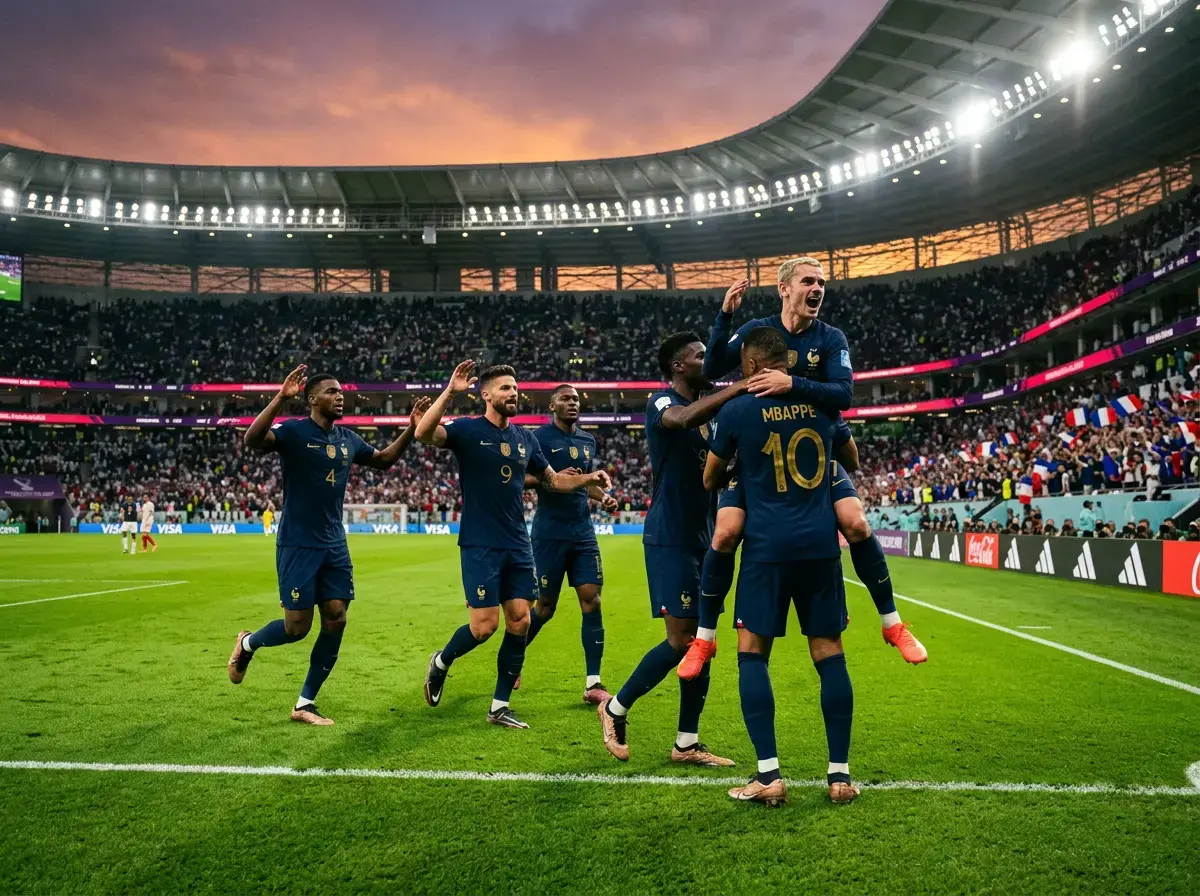
The image haunts French football: Kylian Mbappé standing alone at the penalty spot in Lusail, having just completed a perfect hat-trick in the World Cup final, watching Gonzalo Montiel step up to seal Argentina’s victory. That December night in Qatar produced the greatest final in tournament history, and France were on the wrong side of it. Three goals from Mbappé, a superhuman effort to drag his team back from 2-0 down, and still defeat. The psychological scars from that loss run deep, and they shape everything about France’s approach to World Cup 2026. This is a revenge mission, and the entire nation knows it.
France World Cup betting markets position Les Bleus among the genuine favourites, with outright odds of approximately 5/1 at most Irish bookmakers. That pricing reflects a squad of extraordinary depth — Mbappé leads an attack featuring genuine world-class options across every position, while the midfield and defensive units have evolved since Qatar without losing their fundamental quality. Didier Deschamps remains in charge, his pragmatic approach having delivered two World Cup finals in three tournaments. The question is whether pragmatism can finally secure the trophy that has eluded this golden generation.
I rate France as genuine contenders at current prices. The 5/1 odds imply approximately 17% probability of winning, which feels marginally generous given the squad quality and tournament experience Deschamps brings. My value assessment sits at 7/10 — better than Brazil, comparable to Argentina, and ahead of England. France possess the ability to win this World Cup, and the Qatar final defeat provides motivation that could prove decisive in tight knockout matches. The risk lies in Deschamps’ conservative instincts, which have frustrated supporters even as they delivered results. If France attack with intent rather than merely avoiding defeat, they are capable of beating anyone.
Squad Quality: Depth That Rivals Anyone
French football has spent two decades developing players through academies that rival any in Europe. The results are visible in every position: multiple world-class options competing for starting roles, young talents ready to deputise, and experienced heads providing leadership when matches demand composure. Deschamps faces selection headaches that other managers would envy.
Mike Maignan has established himself as the clear first-choice goalkeeper following Hugo Lloris’ international retirement. The AC Milan shot-stopper combines excellent reflexes with commanding presence, his ability to sweep behind a high defensive line providing tactical flexibility that Lloris could not match in his later years. Maignan’s distribution adds another dimension to French buildup play, his long balls frequently bypassing opposition pressing to find attackers in dangerous positions.
The defensive options are extraordinary. William Saliba has matured into one of the world’s elite centre-backs, his composure and reading of the game anchoring both Arsenal and the French national team. Alongside him, Dayot Upamecano provides physical presence and recovery speed, though his occasional lapses in concentration remain a concern. Ibrahima Konaté offers an alternative with similar physical attributes but greater consistency. At full-back, Theo Hernández continues despite the retirement of his brother Lucas, his attacking instincts making him a genuine threat from the left. Jules Koundé provides right-back cover with the ability to play centrally if required.
Midfield depth allows Deschamps to construct different tactical profiles depending on opposition. Aurélien Tchouaméni has become the anchor, his defensive awareness and passing range making him essential to French structure. N’Golo Kanté’s international career has wound down, but Eduardo Camavinga offers dynamic qualities that compensate — his ability to carry the ball through midfield creates transitions that opponents struggle to contain. Antoine Griezmann continues to operate in the spaces between midfield and attack, his intelligence and work rate making him invaluable despite questions about his best position.
The attack requires no introduction. Kylian Mbappé is the most feared player in world football, his combination of pace, technique, and finishing ability creating matchups that no defender can consistently win. His move to Real Madrid has added new dimensions to his game — Mbappé now drops deeper, combines with teammates, and orchestrates attacks as well as finishing them. The burden of that Qatar final sits on his shoulders, and the desire to atone drives everything he does. Alongside Mbappé, Ousmane Dembélé provides width and unpredictability from the right, while Marcus Thuram has emerged as a genuine centre-forward option. The depth extends to Randal Kolo Muani, Bradley Barcola, and emerging talents who would start for most other nations.
The integration of youth talent ensures French football remains in good health beyond this tournament. Warren Zaïre-Emery has established himself as one of Europe’s most promising midfielders despite his age, his composure and passing range suggesting a future starter rather than mere squad player. Michael Olise provides creative options from wide positions, his ability to beat defenders and deliver quality crosses making him a valuable alternative to established starters. This conveyor belt of talent means France can replace any injured player without significant quality drop-off — a luxury that reduces the risk factors inherent in tournament football.
Group I Preview: France’s Group Stage
France’s group draw produced opponents that should not threaten qualification. Group I contains Norway, Senegal, and Iraq — a mix of European solidity, African quality, and debutant enthusiasm that France should navigate without incident. The danger lies in underestimating opponents rather than genuine competitive threat.
Norway represent the primary opposition, with Martin Ødegaard and Erling Haaland forming an attacking partnership capable of hurting any defence. The Arsenal captain provides creative quality that unlocks organised defences, while Haaland’s physical presence and finishing ability make him one of the world’s most dangerous strikers. France versus Norway has the potential for an entertaining group-stage match, with both sides possessing the firepower to score multiple goals. I expect France to win 3-1 or 2-1, with Norway providing genuine resistance before French quality tells.
Senegal bring African organisation and individual quality that makes them dangerous against any opponent. Sadio Mané’s international career continues despite reduced club importance, his experience and work rate setting the tone for a team that reached the Africa Cup of Nations final repeatedly. The Lions of Teranga possess defensive discipline refined under Aliou Cissé, making them difficult to break down even for elite attacking sides. France should win this match 2-0 or 1-0, with patience required to unlock a stubborn Senegalese defence.
Iraq complete the group as the least fancied side, their qualification through the expanded Asian pathway representing a significant achievement. The gulf in quality between Iraq and France is enormous, and this fixture offers Deschamps an opportunity to rotate his squad while still securing comfortable victory. A 4-0 or 5-0 scoreline seems likely, with second-string players given minutes to maintain sharpness.
The group-stage pathway should yield maximum points, positioning France as Group I winners. This places them in a favourable bracket, likely facing a third-placed team in the Round of 32 before potentially meeting the Group F or E runner-up in the Round of 16. The path to the semi-finals looks manageable, with genuine tests only arriving in the quarter-finals or later. This gradual escalation of difficulty suits Deschamps’ approach perfectly — he can use early matches to establish rhythm and confidence before the pressure intensifies in knockout rounds.
The American venues suit French players accustomed to varying conditions. Matches in climate-controlled stadiums eliminate the humidity concerns that affect summer tournaments, while the modern facilities and travel infrastructure reduce the logistical challenges that sometimes disrupt tournament preparation. France’s large diaspora in North America will ensure vocal support at every group-stage fixture, creating home-like atmospheres despite neutral ground designation. These marginal advantages accumulate across a tournament’s duration.
The Mbappé Era: Captain Fantastic
Kylian Mbappé inherited the French captaincy from Hugo Lloris with the weight of expectation that accompanies everything he does. At 27, he has already won a World Cup, scored in a World Cup final, and established himself as the face of French football for a generation. The Qatar final defeat added fuel to a competitive fire that already burned hotter than most. Mbappé wants this World Cup with an intensity that shapes every aspect of his preparation.
His evolution at Real Madrid has been fascinating to observe. The raw pace and finishing that made him a teenage sensation remain, but Mbappé now combines these attributes with tactical intelligence that earlier stages of his career lacked. He understands when to make runs behind, when to drop deep and combine, when to take on defenders and when to pass. The selfish tendencies that occasionally frustrated Paris Saint-Germain teammates have given way to a more complete understanding of how to maximise team performance while still delivering individual brilliance.
The captaincy has added responsibility without diminishing his output. Mbappé speaks with authority in team meetings, demands standards from teammates, and leads through actions as much as words. His relationship with Deschamps has evolved from player-coach dynamic to genuine partnership, with Mbappé now influencing tactical decisions in ways that previous generations of players did not. This maturity makes him more dangerous than ever — opponents cannot simply plan to contain Mbappé the forward, they must account for Mbappé the leader who lifts his entire team.
The comparison to Ronaldo Nazário feels increasingly appropriate. Like the Brazilian at similar stages of his career, Mbappé possesses the ability to decide matches through moments of individual brilliance that other players cannot replicate. The speed remains otherworldly, but now it combines with decision-making refined through hundreds of high-pressure matches. When Mbappé receives the ball in transition, defenders face an impossible choice: commit and be beaten for pace, or stand off and allow the shot. Neither option offers good outcomes, which explains why opponents consistently foul him rather than attempt fair challenges.
For betting purposes, Mbappé represents the primary individual market for French bets. His odds for Golden Boot typically sit around 6/1, reflecting both his goal threat and France’s likely deep tournament run. I rate this 7/10 for value — Mbappé’s conversion rate and the volume of chances French attackers create suggest he will contend for top scorer. His odds to score in the tournament are prohibitively short at around 1/5, offering no value despite near-certainty of success.
Deschamps’ Flexibility: Multiple Systems
Didier Deschamps has managed France since 2012, a tenure that spans three World Cups and three European Championships. His tactical philosophy prioritises defensive solidity without sacrificing attacking threat — a balance that has delivered consistent results even as critics demand more entertaining football. The key to French success lies in Deschamps’ willingness to adapt his system to opposition and circumstance.
The base formation is a 4-3-3 that can compress into a 4-5-1 when defending or stretch into a more attacking shape when chasing games. Mbappé typically operates on the left wing, cutting inside onto his stronger right foot, while the right winger — usually Dembélé or Griezmann — provides width and work rate. The single striker role has rotated between Giroud (now retired), Thuram, and Kolo Muani, with Deschamps selecting based on opposition profile rather than fixed hierarchy.
Against stronger opponents, Deschamps condenses his team and invites pressure before counter-attacking with devastating speed. This approach proved effective against Argentina in the Qatar final — France absorbed early dominance before exploding into life with Mbappé’s brilliance. The risk lies in requiring individual moments of genius to create chances rather than systematic attacking play. When those moments arrive, France are lethal; when they do not, matches can become frustrating affairs where possession statistics favour France without chances following.
The tactical flexibility extends to personnel decisions. Griezmann can operate as a number ten, a second striker, or a wide midfielder depending on match requirements. Camavinga offers defensive solidity or attacking drive based on how Deschamps deploys him. Even Mbappé has shown willingness to play through the centre when tactical situations demand. This adaptability makes France difficult to prepare for — opponents cannot predict which system Deschamps will employ until the match begins.
Set pieces represent an underrated strength. Griezmann’s delivery from corners and free kicks combines with aerial presence from Upamecano, Saliba, and Tchouaméni to create consistent chances. France scored four goals from dead-ball situations in Euro 2024 qualification, demonstrating proficiency that translates to tournament football where margins are tight.
Betting Value: Are France Underrated?
France at 5/1 implies approximately 17% probability of winning the tournament. This pricing places them behind Argentina (7/2) and marginally behind Brazil (9/2), which feels like slight undervaluation given squad depth and tournament experience. My assessment places France’s true probability closer to 20%, making current odds attractive for value-seekers.
My value rating for France outright sits at 7/10 — higher than Brazil and England, comparable to Argentina. The psychological motivation from the Qatar defeat adds an intangible factor that odds cannot fully capture. France want revenge, and their squad possesses the quality to achieve it. I would recommend modest stakes on France outright at 5/1 for those seeking tournament-long engagement.
France to reach the final is available at approximately 2/1, implying 33% probability. I rate this 8/10 for value — the group draw facilitates comfortable qualification, and the bracket should open favourably through the early knockout rounds. The semi-final represents the meaningful hurdle, likely against Argentina, Brazil, or England. Even assuming a coin-flip outcome in that match, France’s path to the final looks clearer than the odds suggest.
Mbappé for Golden Boot at 6/1 deserves serious consideration. His goal threat exceeds any other player in the tournament, and France’s expected deep run provides opportunities for accumulation. The competition from Kane, Vinícius, and Messi keeps the odds attractive, while Mbappé’s tournament record — four goals in 2018, three in 2022 — demonstrates his ability to perform on the biggest stage. I rate this 7/10 for value.
Team totals offer an interesting angle. France over 8.5 tournament goals is available at evens, implying they need to average approximately 2.8 goals across minimum three matches. French attacking quality supports this line, particularly given the group-stage opponents they face. In qualification, France averaged 2.7 goals per match — right on target for this total. I rate the over at 6/10 — reasonable odds for a reasonable proposition.
My Verdict: Revenge Mission?
France possess everything required to win World Cup 2026. Mbappé leads an attack of extraordinary depth and quality. The defensive unit has evolved without losing its fundamental solidity. Deschamps’ experience of tournament football provides tactical pragmatism that delivers results. And the psychological motivation from Qatar provides edge that money cannot buy. This is a team with unfinished business, and they know it.
The Qatar final defeat has become a defining reference point for this generation. Players who experienced that night — Mbappé, Griezmann, Tchouaméni, Upamecano — carry the memory with them into every subsequent match. The desire to atone drives preparation, training intensity, and match-day focus in ways that external observers cannot fully appreciate. French football writers describe a changed mentality since Lusail: less complacency, more urgency, greater attention to the details that separate winning from losing. Whether this psychological shift translates to on-pitch results remains to be proven, but the motivation is undeniably real.
My prediction places France in the final, likely facing Argentina in a rematch that football fans worldwide would relish. Whether they win depends on margins impossible to predict: individual brilliance, refereeing decisions, penalty shootout fortune. What I can say with confidence is that France will be competitive at every stage. They will not make the same mistakes twice.
The Deschamps question looms largest. His conservative instincts have delivered consistent results — two World Cup finals in three tournaments — but also frustrating knockout defeats where France appeared content to wait rather than attack. If Deschamps trusts his attacking quality and plays with intent, France can beat anyone. If he reverts to caution, the same patterns that characterised previous exits could repeat. The tension between pragmatic coaching and exceptional attacking talent defines French football in the modern era.
For betting purposes, I recommend France to reach the final at 2/1 as the primary wager. This captures their quality while providing protection against semi-final variance. Supplement with Mbappé for Golden Boot at 6/1 for individual exposure. And consider modest outright stakes at 5/1 — the value exists for those willing to back French revenge.
