

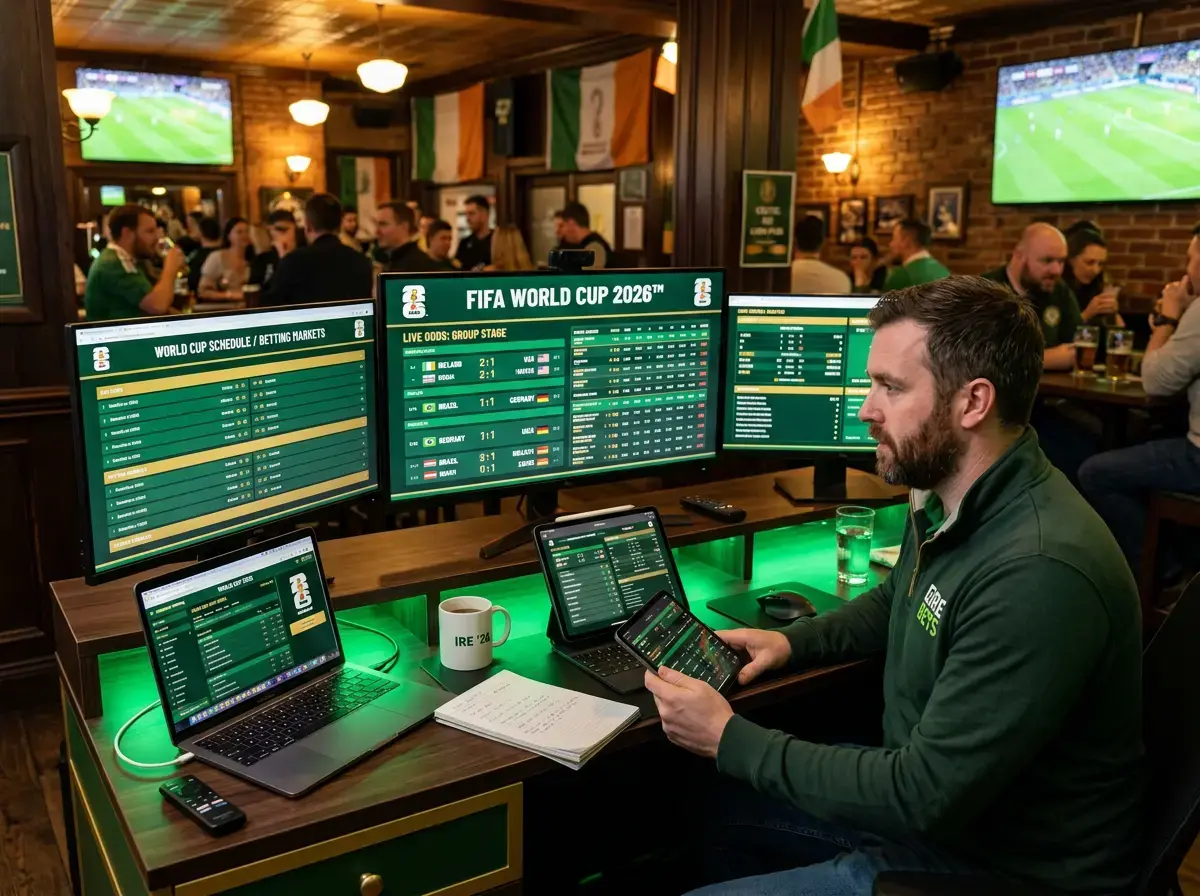
I placed my first World Cup bet in 2002, backing Ireland to beat Germany in the group stage. The local bookmaker — a small shop on Talbot Street that no longer exists — offered me 7/2, and Robbie Keane’s last-minute equaliser delivered one of the great Irish football moments. That bet cost me five pounds and returned nothing, since we only drew. But the experience hooked me on World Cup betting in ways that have shaped my professional career. Twenty-four years later, the landscape has transformed beyond recognition. Online operators dominate, mobile apps have replaced betting slips, and Irish punters have access to more markets and better odds than any previous generation. Choosing where to place your World Cup 2026 bets matters more than ever.
This guide reflects nine years of experience analysing betting markets and seven World Cups of active punting. I have accounts with every major operator serving Ireland, and I regularly compare odds, features, and customer service across the industry. What follows represents my honest assessment of which bookmakers offer the best value for Irish punters during the 2026 tournament. I have no commercial relationships with any operator — my recommendations reflect genuine evaluation rather than promotional incentives.
The Irish betting market operates under the Gambling Regulation Act 2024, enforced by the Gambling Regulatory Authority of Ireland since February 2026. All operators mentioned in this guide hold valid Irish licences, meaning your deposits are protected and your winnings will be paid. The regulatory framework provides consumer protections that did not exist during previous World Cups, including dispute resolution mechanisms and responsible gambling tools. Wherever you choose to bet, ensure the operator displays their GRAI licence number prominently — unlicensed operators offer no legal protections if something goes wrong.
How I Rate Bookmakers: My Criteria
Every punter values different attributes in their betting experience. Some prioritise odds quality above everything else; others want extensive market coverage or reliable mobile apps. My rating system attempts to balance these competing priorities while acknowledging that individual preferences will vary. I evaluate each operator across five categories, scoring from 1-10 in each area before calculating an overall assessment.
Odds quality receives the highest weighting in my system. Over a tournament like the World Cup, small differences in odds compound significantly. If one bookmaker consistently offers 5% better prices than competitors, a punter placing twenty bets across the tournament could see materially different returns from identical selections. I test odds quality by comparing prices on benchmark markets — outright winner, match results, and popular player props — across all major operators at regular intervals.
Market coverage matters for punters who want more than simple match betting. World Cup tournaments offer unique opportunities in group-stage combinations, knockout brackets, and player-specific propositions. Some operators excel in exotic markets while offering limited options for standard bets; others provide comprehensive coverage without innovation. I evaluate both breadth and depth of market offerings.
User experience encompasses mobile app quality, website functionality, deposit and withdrawal speed, and customer service responsiveness. A bookmaker offering excellent odds becomes worthless if you cannot place bets reliably or withdraw winnings promptly. I test these factors through actual use rather than theoretical assessment.
In-play betting deserves separate evaluation for World Cup betting. Live markets create opportunities that pre-match betting cannot replicate, and the quality of live odds, speed of settlement, and breadth of in-play options varies dramatically between operators. For punters who intend to bet during matches, in-play quality may outweigh other considerations.
Finally, I assess promotional offerings and loyalty programmes. Sign-up bonuses, enhanced odds, and accumulator insurance can add value when used strategically. However, I weight these factors below operational quality — a bookmaker offering generous promotions but poor odds remains a poor choice for serious punters.
Irish Operators vs International: The Verdict
Irish punters face a fundamental choice between operators headquartered domestically and international giants serving multiple markets. Both options offer legitimate advantages, and the optimal choice depends on individual priorities and betting patterns.
Irish-headquartered operators — Paddy Power, Boylesports, and BoyleSports’ competitors — possess deep understanding of Irish betting culture. Their market offerings reflect what Irish punters actually want, their customer service speaks with Irish accents, and their promotional campaigns reference local sporting events alongside international tournaments. The cultural alignment creates experiences that feel natural rather than generic. When betting on World Cup matches involving Scotland — our adopted Celtic neighbours — Irish operators often provide enhanced coverage that international competitors lack.
The domestic operators also benefit from established retail networks. For punters who prefer occasional shop visits alongside online betting, the ability to deposit cash, collect winnings, or simply chat with staff provides value beyond pure odds comparison. The high-street presence also means Irish operators have reputations to protect locally — customer service failures become local news in ways that would not affect distant international corporations.
International operators counter with technological advantages and economies of scale. Bet365’s live streaming coverage exceeds anything Irish operators offer, while Betfair’s exchange model provides alternatives to traditional bookmaking that sophisticated punters appreciate. The larger customer bases allow international operators to offer more markets and accept higher stakes without flinching. For punters placing significant sums on obscure markets, international operators often prove more accommodating.
Odds quality varies situationally rather than systematically. Irish operators sometimes offer better prices on markets they understand deeply — Scottish football, for example — while international operators frequently win on benchmark events where their scale provides pricing advantages. The optimal strategy involves maintaining accounts with multiple operators and shopping for best prices on each bet rather than committing exclusively to a single provider.
My verdict favours a hybrid approach. Primary accounts with one or two Irish operators for their market knowledge and cultural alignment, supplemented by international accounts for specific situations where they offer clear advantages. The GRAI licensing framework means all operators face identical regulatory requirements, so the choice involves preference rather than safety.
Features That Matter: Cashout, Live Betting, Accas
Modern betting platforms offer features that would have seemed impossible during previous World Cups. Understanding which features add genuine value — and which serve primarily as marketing tools — helps punters make informed decisions about where to concentrate their activity.
Cashout functionality has transformed how punters approach accumulators and long-term bets. The ability to lock in profit before all selections have settled, or to limit losses when early selections have failed, adds flexibility that previous generations of punters lacked. However, cashout pricing varies dramatically between operators. Some offer fair valuations that reflect true probability; others effectively charge substantial premiums for the privilege of early settlement. I test cashout quality by comparing offered prices against theoretical valuations calculated from current odds.
The best operators offer partial cashout alongside full settlement options. This feature allows punters to secure some profit while leaving a portion of the bet running — a particularly valuable tool for World Cup outright bets where early tournament performance creates opportunities to hedge positions. Not all operators provide partial cashout consistently, and the feature may disappear on certain markets or during specific time periods. Understanding each operator’s cashout policies before placing significant bets avoids unpleasant surprises.
Live betting quality separates genuine competitors from also-rans. World Cup matches generate enormous in-play betting volume, and operators respond differently to this demand. The best platforms offer comprehensive market coverage during matches, with rapid settlement of winning bets and competitive odds that reflect developing match situations. Weaker operators restrict live markets to basic options, delay bet acceptance during crucial moments, or offer odds that fail to reflect actual match dynamics.
Streaming integration enhances live betting experiences significantly. Watching matches through your betting app, with in-play markets displayed alongside the action, creates seamless betting experiences that separate screens cannot replicate. Not all operators offer streaming for World Cup matches — rights restrictions vary by territory and competition — but those that do gain meaningful advantages for in-play focused punters.
Accumulator features vary between operators but often provide genuine value. Acca insurance returns stakes when one selection fails in larger accumulators, reducing the all-or-nothing nature that makes accas frustrating. Acca boosts enhance returns on winning accumulators, effectively providing better odds without changing prices on individual selections. The terms and conditions surrounding these features merit careful reading — restrictions on qualifying markets, minimum odds requirements, and maximum payout limits all affect actual value.
Betting in Ireland: What You Need to Know
The regulatory landscape for Irish betting has evolved significantly since the Gambling Regulation Act 2024 came into force. Understanding the framework helps punters make informed decisions while avoiding pitfalls that could affect their betting experience.
The Gambling Regulatory Authority of Ireland assumed full responsibility for licensing and enforcement in February 2026, replacing the previous Revenue Commissioners oversight. All operators accepting bets from Irish customers must hold valid GRAI licences, displayed prominently on their websites and apps. The regulatory framework requires operators to verify customer identities, implement responsible gambling measures, and maintain segregated customer funds that protect deposits in the event of operator insolvency.
Advertising restrictions have tightened under the new regime. The watershed rules prohibit gambling advertisements on television and radio between 5:30 and 21:00, protecting younger audiences from exposure. Online advertising faces additional restrictions around targeting and content, though operators retain considerable freedom outside these boundaries. For punters, these restrictions mean fewer promotional offers than previous tournaments — but the remaining offers tend to provide better value since operators concentrate marketing budgets on genuine incentives rather than blanket advertising.
Responsible gambling tools have become mandatory across all licensed operators. Self-exclusion schemes allow punters to ban themselves from gambling platforms for defined periods, while deposit limits, loss limits, and session time reminders help individuals manage their betting activity. These tools work across all GRAI-licensed operators through shared databases, meaning self-exclusion from one platform triggers exclusion from all licensed Irish operators. Punters struggling with gambling behaviour should use these tools without hesitation — they exist precisely because previous generations lacked such protections.
Taxation does not directly affect punters in Ireland. Operators pay betting duty on their Irish revenue, but winnings remain tax-free for customers. This contrasts with some other jurisdictions where gambling winnings attract income tax, making Ireland an attractive environment for serious punters. The operator tax does indirectly affect odds quality, since bookmakers must factor their tax burden into pricing — but this cost has been present for decades and operators have long since adjusted their models accordingly.
My Final Pick: Where I’m Placing My Bets
After evaluating all available options across my rating criteria, I have structured my World Cup 2026 betting across three primary accounts plus additional options for specific situations.
My primary account for match betting and standard markets sits with an Irish-headquartered operator whose odds quality consistently matches or beats international competitors on the markets I most frequently access. The cultural alignment matters to me — customer service that understands Irish betting culture, market coverage that reflects what I actually want to bet on, and promotional offerings tied to events I care about. The mobile app functions reliably, cashout pricing seems fair, and withdrawal processing has never caused issues in my experience.
For live betting during matches, I maintain a secondary account with an international operator whose streaming integration and in-play market coverage exceed anything Irish operators currently offer. The odds quality on live markets justifies the slight inconvenience of managing multiple accounts. When Scotland play their Group C matches at 02:00 Irish time, I will be watching through this platform while placing in-play bets on the same screen.
Exchange betting through Betfair provides alternatives that traditional bookmaking cannot match. The ability to lay bets — effectively acting as the bookmaker — creates hedging opportunities that prove valuable during knockout rounds. Lay betting allows me to lock in profits on outright positions without accepting poor cashout offers, while back-to-lay strategies on short-priced selections provide edge that traditional betting cannot replicate.
For accumulator betting, I compare promotional offerings across all my accounts before placing each bet. Acca insurance and boost promotions vary weekly, and the optimal choice depends on specific selections rather than general operator preference. This shopping approach adds time to the betting process but delivers meaningful value over a tournament’s duration.
My recommendation for most Irish punters involves establishing accounts with at least two operators — one Irish-headquartered and one international — before the tournament begins. Complete identity verification early to avoid delays when you want to place bets. Familiarise yourself with each platform’s features through small bets on pre-tournament friendlies. When the World Cup kicks off on 11 June, you will be ready to access the best prices and features across the market rather than limiting yourself to a single operator’s offerings.
The practical advantages of multi-operator betting extend beyond odds comparison. Different operators frequently offer enhanced odds on specific matches or markets, providing value that single-platform punters cannot access. Promotional calendars vary between operators, meaning accumulated free bets and bonuses provide ongoing value throughout the tournament. And the security of having backup options matters during high-demand periods when individual platforms may experience technical difficulties or slow bet acceptance.
For serious World Cup betting, I suggest exploring the comprehensive betting guide that covers market selection, bankroll management, and strategic approaches to tournament betting. The bookmaker choice provides the foundation, but profitable betting requires understanding markets as much as understanding platforms.
